Catalogue for the Dandy Traveller

First of all, a big cheery hello to you all. I have missed you so. This being such an addiction and all that thrown into the miss-you mixture.

It was bank holiday and our itchy feet took us north into Yorkshire, into heart of the green dales which you have been introduced to in my posts Up and Down the Yorkshire Dales and Crackpot Hall on the Dales. Three days of walking did wonders for our souls. There’s nothing like a spot of walking, meeting strangers, exchanging random notes – often about furry mates because the Englishman and his dog shall not be parted – then sitting in a pub with a pint and a hefty plate of roast meat or pie with a fire crackling  in the backdrop.

Now when Adi sits down with a plate of lamb leg and Yorkshire pud in front of him, I make him squirm. ‘Imagine the lamb you have been cooing to. You petted his tiny woolly head at Ed’s (the farmer we stayed with in Cornwall) and he looked at you with those trusting pretty eyes. And then bam, here you are, sinking your teeth into him.’

Adi has decided to give up lamb. That is, he told me, after he finished his plate of lamb. Wily creature.

I shall do a post about it all later because there were hair-raising climbs thrown in too into this holiday. I survived them and sit here clacking away on Bertie (my Macbook) and sometimes thunk heavens for normalcy.

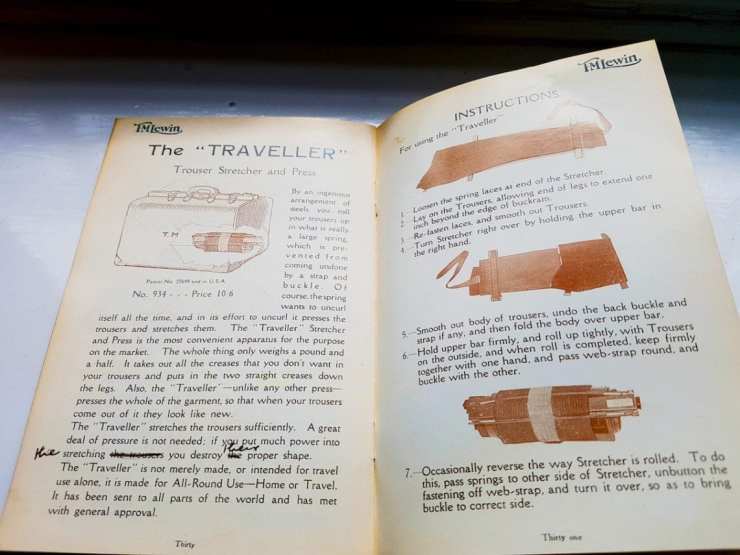
But I thought I should share this wonderful little vintage Victorian catalogue from 1905 that appeared in our box from T.M. Lewin since my husband is a dedicated customer of the British gentleman’s dress shirt retailer. Just like he got it today, in 1905 the retailer sent its catalogues to customers all over the world.

Now cast your imagination back to a time, ladies and gentlemen, when men wore three-piece lounge suits, collars starched and in place, ties knotted perfectly and jackets narrow with small, high lapels. A bowler cap, and sometimes, a flat cap completed the picture. Young men had short hair and trimmed moustaches. Beards were not so popular with the young as is the trend with the natty young men of today. They were the realm of the older men to keep and preserve, thank you.

Do you know of the Regency dandy Beau Brummell? He used to be a fixture in my Georgette Heyer reads during the teenage years, so I was introduced to him quite young. I will not pontificate about him. The link between T.M. Lewin and Beau Brummell is that they both stand on Jermyn Street in London, home to resident shirtmakers of the likes of T.M. Lewin, Turnbull & Asser, Hawes & Curtis, Charles Tyrwhitt and a few traditional shoe- and boot-makers too. Apart from these ‘propah’ shops where you get everything a gentleman might want, from hats, shoes, shaving brushes and braces to collar stiffeners, stands dandy Beau in brass looking down his fine aquiline nose upon you. If you are not dressed well enough for him, he shall hang you by your breeches.

No breeches? Beau is gobsmacked.

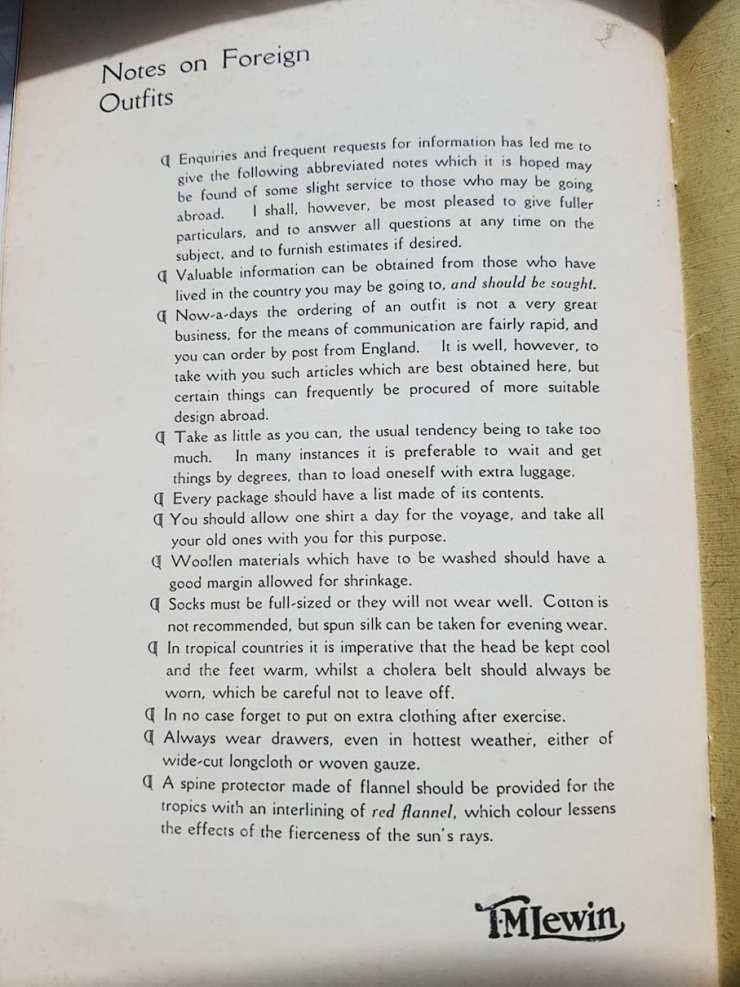
Also there are a few pages from the catalogue with notes for the traveller of those days. 

Beau Brummell 6.jpg
Beau Brummell, the arbiter of fashion in times gone by
2017-04-29 07.46.26 1.jpg
The details of how you fixed your business deals with the shirtmaker
2017-04-29 07.46.28 1.jpg
Matters of conversion; taking stock of the wardrobe
2017-04-29 07.46.26 2.jpg
The Rules to getting your shirt right
2017-04-29 07.46.25 1.jpg
Notes for the traveller
2017-04-29 07.46.24 1 (1).jpg
Spun silk, ladies and gentlemen. Nothing less shall do.

Portloe

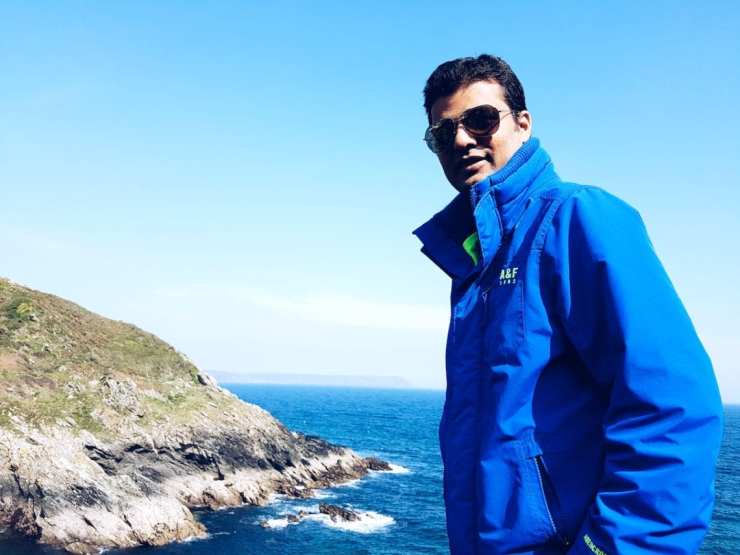
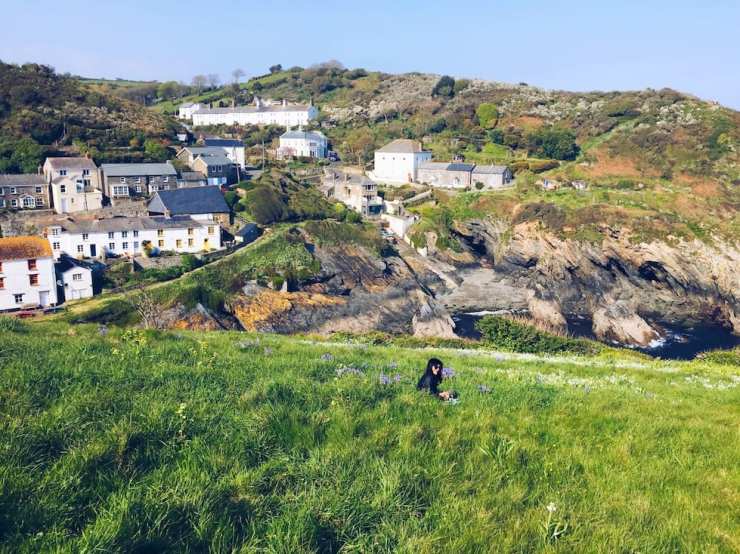
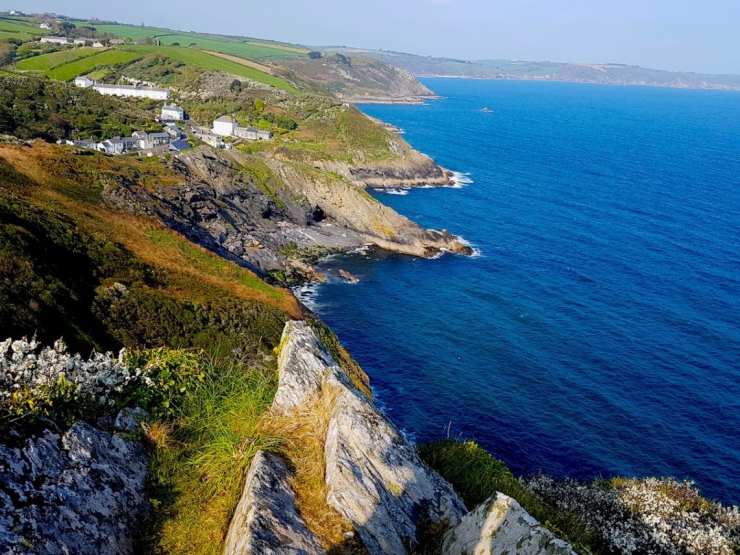
Atop the cliffs of the Roseland Peninsula, I sit on the ledge with the wind in my hair and  the Celtic Sea below me. Had I taken a few hefty steps back in time to let’s say the mid 1800s, I would have peered and spied upon smugglers at work. And wondered if I might claim a share of their loot of French brandy. That is the kind of contraband these smugglers – who doubled up as fishermen –  stored in the cellars of their farmhouses in the village of Portloe.

The scene was serious here on the Roseland Peninsula so much so that Customs had to maintain a strict watch here. I like the ring of the name Portloe which seems to have been a variation of the Cornish word, Port Logh, meaning ‘cove pool’. When you climb down the steep cliffs and reach the valleys, you see the protected cove that gave it its name and you will see how it is one of the most charming villages in Cornwall. Once a busy pilchard fishing village, it has now been reduced to a quiet one where just about three boats work the seas, returning with a haul of crabs and lobster.

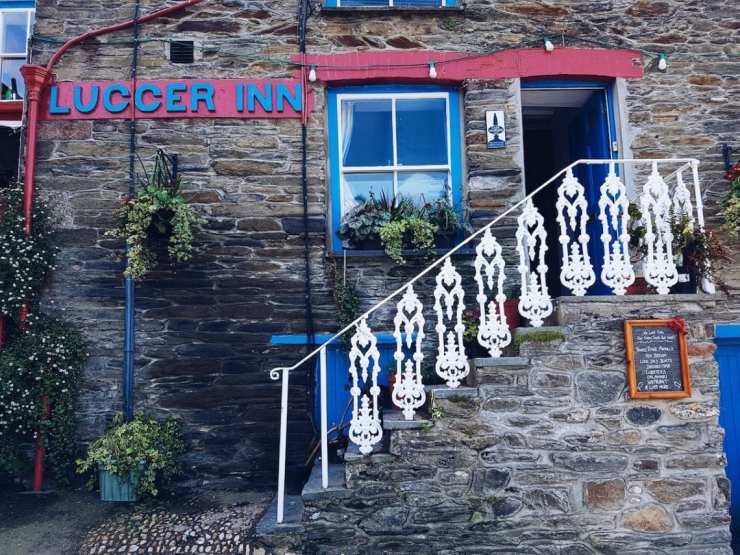
We sat in the old Lugger Inn for a while before we set out on the coastal walk to Portholland. The bummer is that we did not complete the walk because we were a bit late for it, so we quit after halfway up (even this took the better part of an hour with some steep stretches thrown in). Someday we shall do the entire stretch and more.

But the walk just gives and gives.

If you are singing aloud thinking there is no one to hear your hollering, apart from the husband who signed up for it when he married you, look out for the old lady sitting quietly around the bend on a bench hidden from plain sight by overgrown foliage.

Besides the occasional old lady, we saw a man fishing from his perch upon one of the cliffs that meet the shore at some point, and possibly his partner resting on the rocks above him. It made for a peaceful picture.

You can well imagine then that Portloe remains one of my favourite hideouts in Cornwall. I visit it often in my mind’s eye when I crave for the sight of those blue waters, the feel of the wind in my hair and some solitude. For there, you can wander lonely as a cloud.

2017-04-18 09.19.41 1.jpg
The protected cove in the village
2017-04-18 09.19.43 1.jpg
The thoughtful man in the cove
2017-04-18 09.19.44 1.jpg
If you are not staying at the Lugger Inn, do drop by for a coffee or even a lovely high tea with Champagne. But that view makes anything taste like Champagne. Even cappuccino.
2017-04-18 09.19.38 1.jpg
In his elements. Going down steep edges of cliffs.
2017-04-18 09.19.27 1.jpg
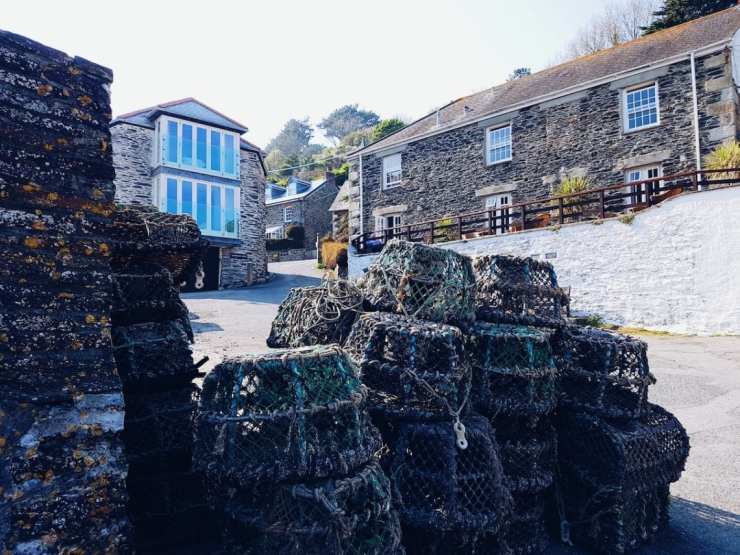
The beautiful stone cottages of Portloe. Give me a room in one of them and I will never want for anything again.

2017-04-18 09.19.22 1.jpg

2017-04-18 09.19.40 1.jpg

2017-04-19 02.52.15 1.jpg
Flowery meadows
2017-04-18 09.19.36 1.jpg
Those blue and yellow-paned cottages can be rented for holidays

2017-04-25 09.20.58 2.jpg

2017-04-18 09.19.17 1.jpg
Views on the coastal walk
2017-04-18 09.19.15 1.jpg
I would go for such an epitaph. Would you?
2017-04-18 09.19.14 1.jpg
The mermaid keeps a watch upon the shore

2017-04-19 02.52.17 1.jpg

Where to Stay: 

Lugger Inn (www.luggerhotel.co.uk). A room at this 17th century inn will cost you upwards of £147 per night. But it has gorgeous views and a restaurant where you can tuck into the local produce.

Cove Cottage. You can book this beautiful cottage with the blue panes by the harbour through Cornwalls Cottages (www.cornwallscottages.co.uk). Prices start at roughly £110 per night for the three-bedroom cottage. But they are booked chock-a-block, so consider booking in advance. The early bird here catches the proverbial worm and what a worm this is.

What to do:

Circular walk from Pendower Beach to Veryan. The story goes that you will pass a spot in Narehead where lived a fisherman, not quite happy in his marriage. Once a week he used to lower his boat into the waters to visit his wife in Veryan and take her a booty of fish.

Walk the coastal path to the cove at Portholland.

Circular walk from Narehead to Portloe. On the path you will spot a Cold War nuclear bunker and a reef called The Whelps because many a ship met its untimely end there.

Giants and Saints of St. Michael’s Mount

On an April noon when an army of clouds invaded the blue sky and cast a black and silver sheen upon the landscape, we arrived in Marazion. Captivated by its name the first time I visited it about four years ago, I fell in love with the ancient market town. You will see why, by and by.

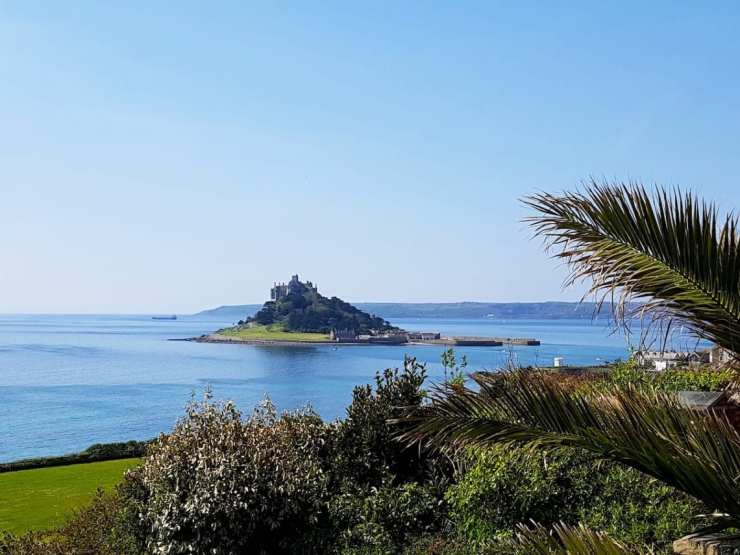
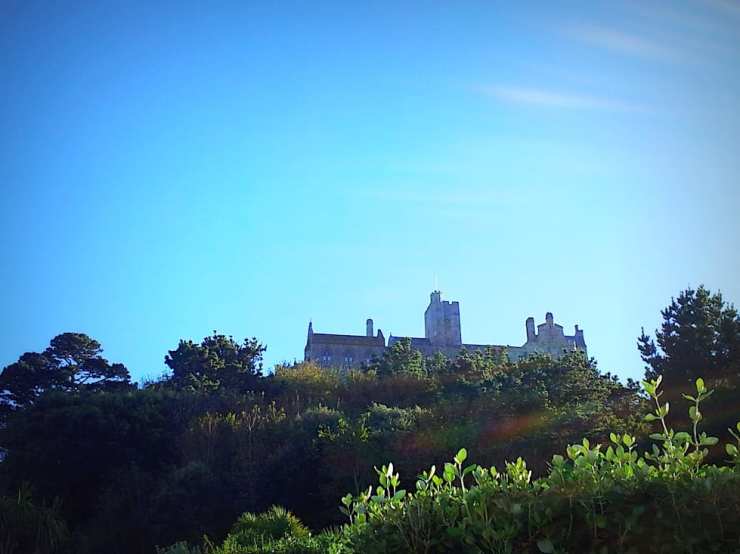
Before I gather steam, here’s a brief note. If you are in Mousehole, Marazion is just a few miles away. Marazion has a ringside view of a fairy-tale island that juts out of the Celtic Sea – St. Michael’s Mount (the silhouetted rocky outcrop you see above). The tidal island is a sister counterpart of St. Mont Michel in France. In the 11th century, it had even been ceded to the Benedictine order of St. Mont Michel till in the 14th century it became the property of an abbess in Middlesex.

Many moons ago, a giant by the name of Cormoran (you will remember Robert Galbraith’s gruff detective has the same moniker) lived upon the island. When he got hungry, the cattle of Marazion were his meal. He was 18 ft. tall and his girth spanned a humble figure of three yards, so crossing the causeway was no big feat for our beef-loving giant. He became a blasted curse upon the town. Who should pop up to be the hero of this town? Jack the Giant-Killer of our childhood stories. He is Cornish, yessir, and he lived in Marazion. Our notable Jack not only killed the giant, but he also went on to slay many more giants, was appointed a Knight of the Round Table by King Arthur.

Now ye of deep faith, you might want to put St. Michael’s Mount on your list of pilgrimage. Sailors on the sea from the 5th century have maintained that a saint appeared on the island to guide them to safety from alluring mermaids and storms. This was the patron saint of fishermen, the archangel St Michael, who is supposed to have delivered a few miracles during the 13th century.

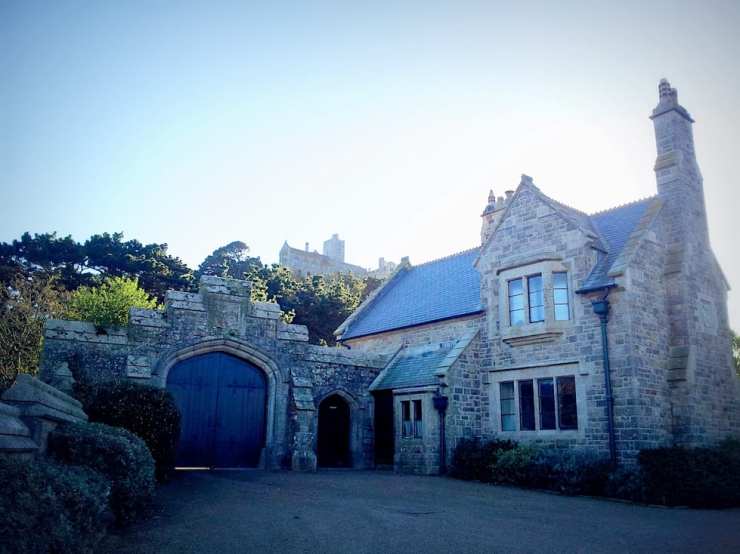
I crossed over the causeway four years ago, leaving behind Adi in the car at Marazion to sleep off his tiredness for a good hour or so. The tide was low and I felt like I was in a dream, walking across the granite cobbles of the causeway, as the waters swirled in and out in a hypnotic rhythm to a fairy-tale castle upon a tidal island. Bells tolled in the old priory and apart from the cawing of a few seagulls, the island was deserted. The castle loomed high above the few stone cottages, home to the staff who work in the castle. Entry to the castle however was closed because it was a Saturday. I spent my time treading through the alleys in the island, exploring the charm of the cottages clustered around it, sitting on the pier and watching boats passing by. Also, I did not have the privilege of meeting either the giant or the saint. My wuss-y heart, I fear, would not have been able to bear the glorious sight of either.

2017-04-20 08.41.22 1.jpg
The tidal island. You cannot spot the causeway because it was high tide at the time the photo was taken.
2017-04-26 01.05.59 1.jpg
This is how the man-made granite causeway looks during low tide. A photo from four years ago when I crossed it to explore St. Michael’s Mount.
2017-04-26 01.05.58 1.jpg
Worker’s cottages and the castle on St. Michael’s Mount

2017-04-26 01.05.58 2.jpg

2017-04-26 01.05.56 1.jpg
Nazi foreign minister Ribbentrop had plans to live on the island after German plans for the conquest of Britain were successful. He was a frequent visitor to Cornwall.
2017-04-26 10.37.10 1.jpg
The castle has been the home to the St. Aubyn family since the 1650s. One of the Lords of St. Levan, descendants of the St. Aubyn family, donated it to the National Trust in 1954 but it shall be the family seat for a period of 999 years.
2017-04-26 10.37.44 1.jpg
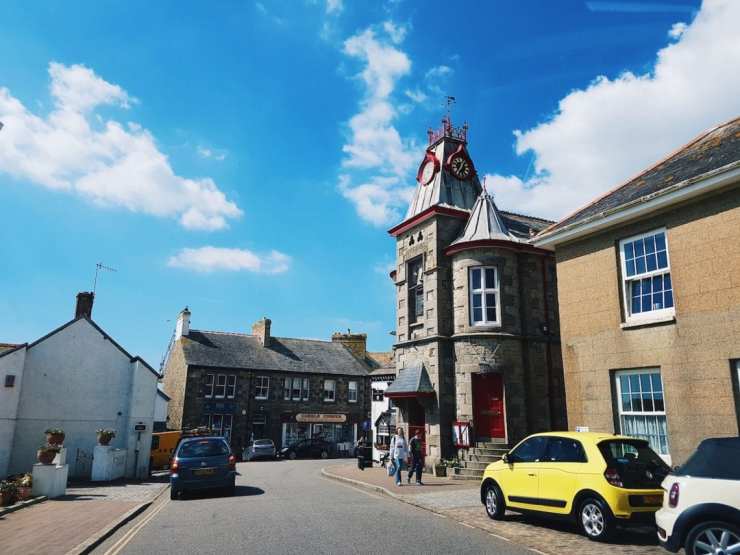
Into the ancient market town of Marazion
2017-04-26 10.37.51 2.jpg
The town hall (with the red pipings) of Marghasyewe, as the town was deemed in Cornish 

2017-04-26 10.37.48 1.jpg

2017-04-26 10.37.43 1.jpg
On a nippy noon step into the King’s Arms for a pint of Cornish ale
2017-04-26 10.37.45 1.jpg
And a pile of onion rings. All eyes were on our table.
2017-04-26 10.37.47 1.jpg
Spot the cocker spaniel?
2017-04-26 10.37.46 1.jpg
Let me make it easier. Now do you see the cute spaniel watching life go by beneath him?

2017-04-26 10.37.48 2.jpg

Getting to St. Michael’s Mount:

Barring Saturday, it is open all other days. Cross the causeway on foot during low tide or take a boat from Marazion to the island for the fares of £2.00 for adults and £1.00 for children.

Entering the Castle: 

Tickets cost 9.50 quid for an adult, garden entry is priced at 7. A combined ticket costs 14 quid. If you are a National Trust member, you get in free. Timings: 10.30am-5pm.

Where to Stay:

The Godolphin Arms (www.godolphinarms.co.uk) offer standard double rooms at about £160 per night on bed & breakfast basis. Some offer spectacular views of St. Michael’s Mount.

Rosario (www.rosario-marazion.co.uk), a bed & breakfast in Marazion, with views of the sea too, offers more modest prices at £90 per night.

Sea, Salts and Sail in Mousehole

In the fishing village of Mousehole in West Cornwall which falls understandably within the Cornish area of outstanding natural beauty (AONB) zone, a maritime festival takes place every two years from which I have culled the title for this post. A photographer called Paul Massey (poor thing shares his name with an English criminal gunned down in 2015) describes it as an incomparable experience. He notes: ‘To watch as the harbour slowly fills with wooden boats is almost akin to time travel. It reminds me of the old sepia postcards showing the Mousehole fleet of fishing luggers lying abreast, hauling canvas and pulling on cordage. The sights, sounds, and smells all mingling to evoke a very different and romantic era. It is a photographer’s dream. When the boats leave to race in the Bay, with St Michael’s Mount in the near distance, it sends a shock of excitement through even the most hardened land lubber.’

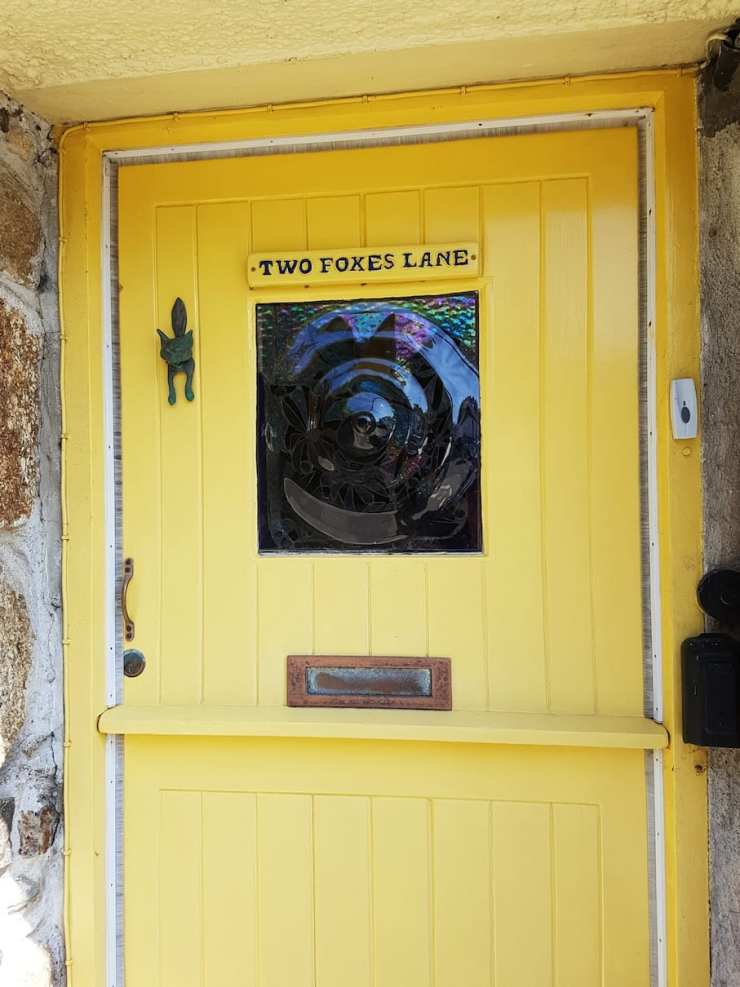
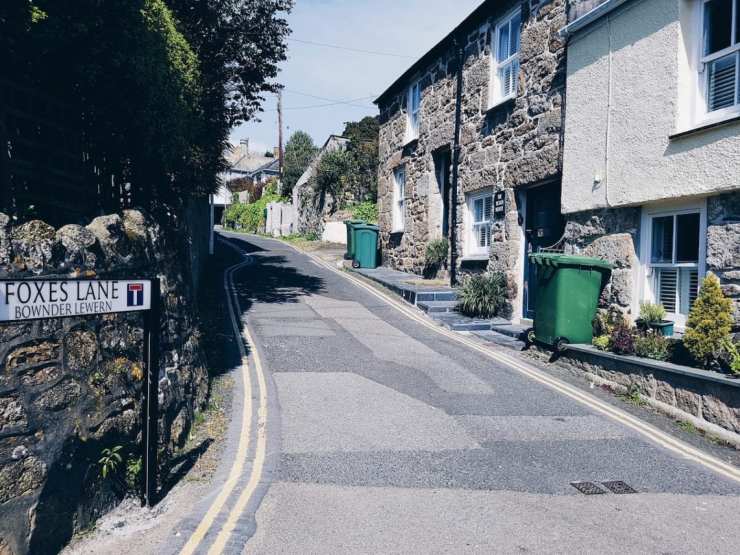
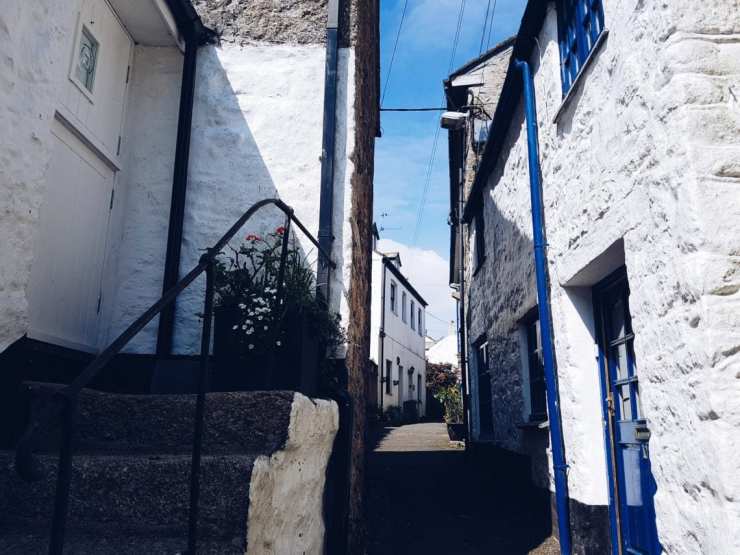
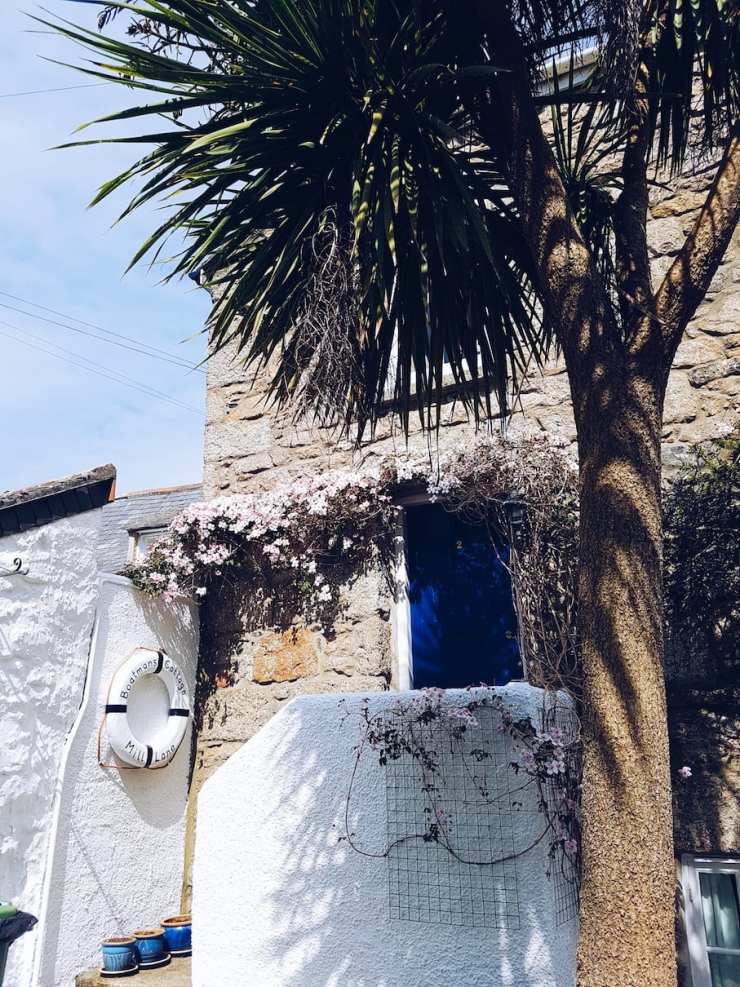
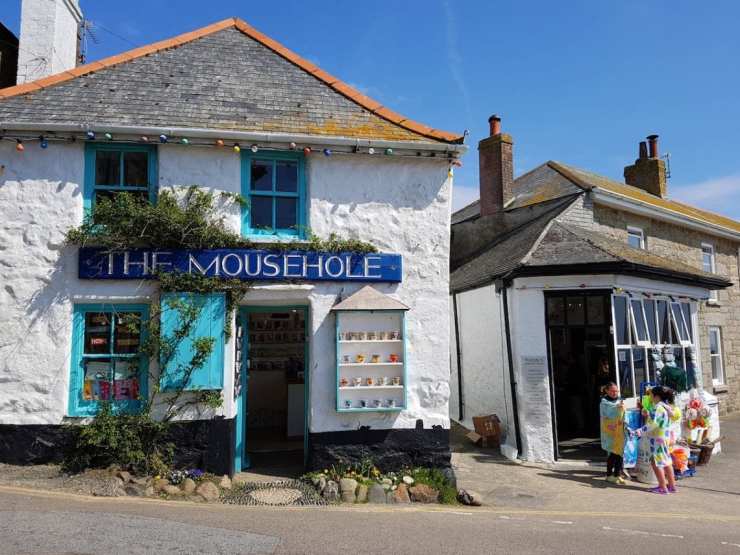
As we entered the village I wondered if foxes strutted about its narrow streets. One of the house owners is supposed to have sighted a fox cub family and named her cottage accordingly. Cottages built with local granite huddled around the alleys. Flowery gardens and rustic garden sheds popped up alongside, and to my delight, pasty shops and galleries too. One of the shops sold candles which promised to make your room smell of the sea. Then came the part of looking at the price tag which succeeded in making the whiff a shade less potent.

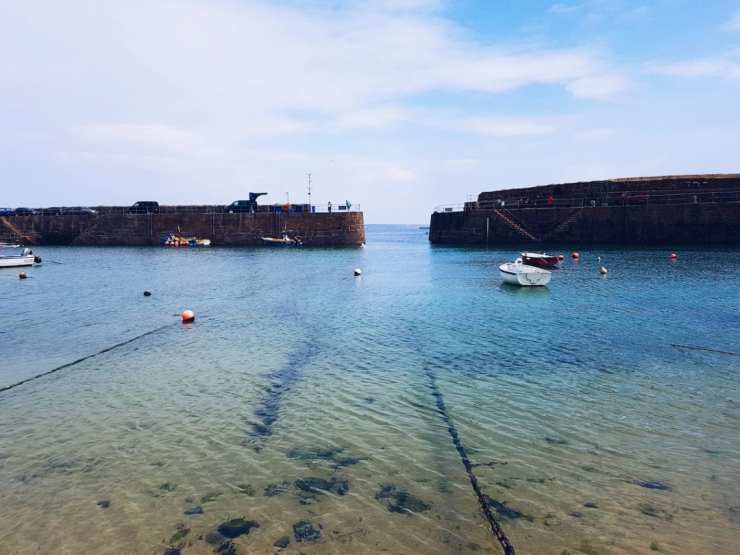
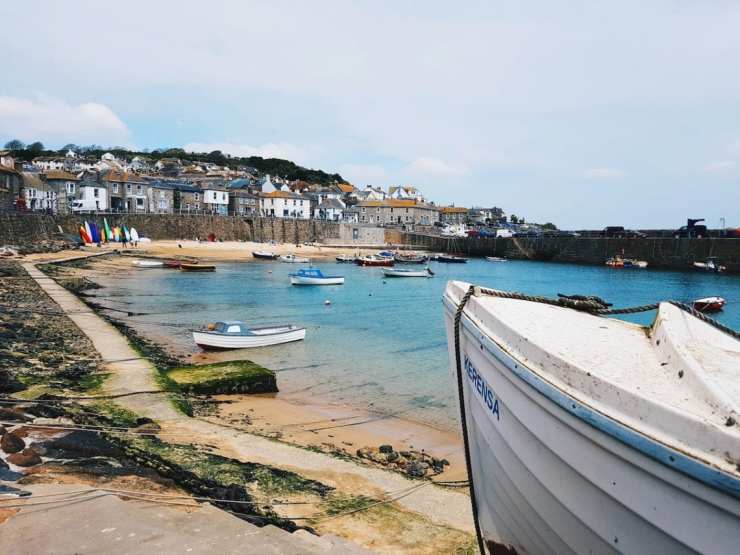
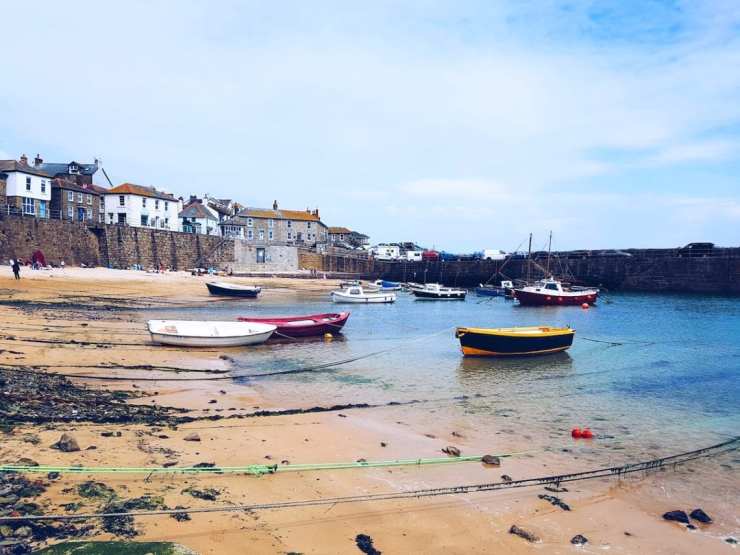
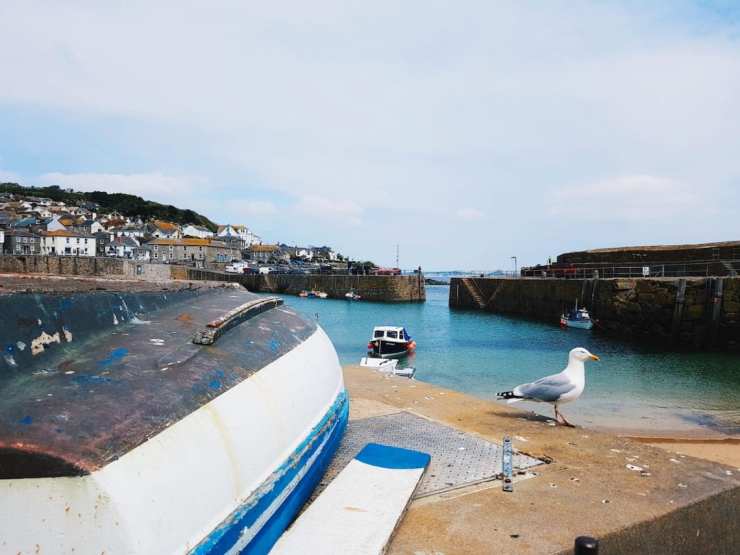
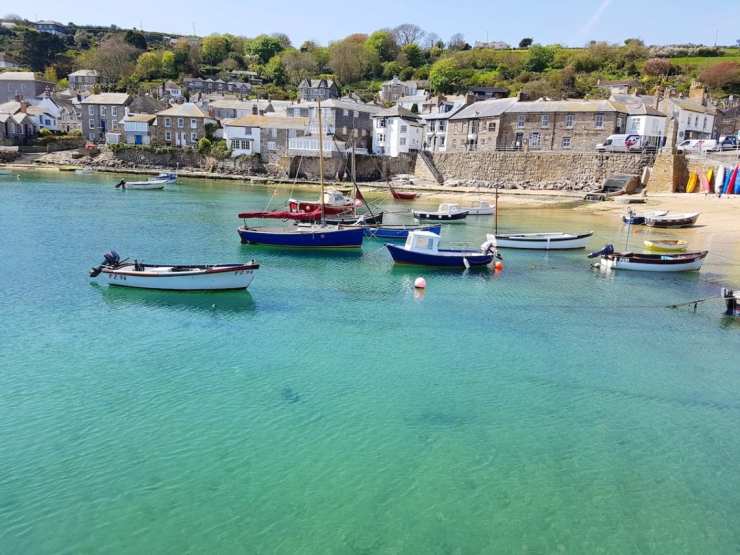
Families sunned themselves on the beach and children went about their serious tasks of building sand castles while girls with pigtails were told off by their fathers in a serious grown-up voice about something or the other – no baby talk here. The village seemed to be protected from the onslaught of the sea by two sturdy breakwaters that popped up on the harbour as a clutch of boats floated upon shallow waters that gleamed in jewel tones of turquoise.

Mousehole – pronounced ‘Mowzel’ please – with the distinct lack of crowds made us feel like it was our personal romping grounds. Did the poet Dylan Thomas comment therefore that it was the loveliest English village? I am sure the Cornish might have had a thing or two to say about being called English.

But do not be fooled by its present unassuming self. Mousehole was once a port of distinction along with nearby Marazion. This was until the 16th century when a marauding band of 400 Spanish men razed the village to the ground – the backdrop to this was the Anglo-Spanish war of 1585-1604. Only one house remained standing and that was the pub, the former Keigwin Arms, which remains but is no longer a pub. On it is a plaque that informs you that ‘Squire Jenkyn Keigwin was killed here 23rd July 1595 defending this house against the Spaniards.’

Now if you are into Stargazy Pie, that Cornish dish which has seven fish heads poking their heads out of the crust to say hello to the eater, this is its birthplace. Every year on December 23, an enormous Stargazy Pie is baked to honour the memory of a local resident, Tom Bawcock, who braved the stormy seas and rescued the village from famine by returning with a haul of seven kinds of fish. Below you shall find examples of its charm.

2017-04-20 08.41.30 1.jpg

2017-04-20 08.41.28 2.jpg

2017-04-20 08.41.47 1.jpg
Breakwater security

2017-04-20 08.41.31 1.jpg

2017-04-20 08.41.32 1.jpg

2017-04-20 08.41.33 1.jpg

2017-04-20 08.41.35 1.jpg

2017-04-20 08.41.38 1.jpg
Looks like we have a Daphne du Maurier fan in the house
2017-04-20 08.41.41 1.jpg
Mr. Personality
2017-04-20 08.41.39 1.jpg
Whitewashed cottages of Mousehole. I have a decided weakness for the colour scheme.

2017-04-20 08.41.39 2.jpg

2017-04-20 08.41.44 1.jpg

2017-04-20 08.41.42 1.jpg

2017-04-20 08.41.45 1.jpg
Lichen-coated harbour of Mousehole

2017-04-20 08.41.49 2.jpg

Processed with VSCO with a5 preset

2017-04-20 08.41.46 1.jpg
Gulls ponder upon the unfairness of life as people with pasties pass by

Slow Monday

Getting back home never fails to cheer me up. We have been away for 10 days and no matter how beautiful the holiday was, the cream teas luscious, the pasties tummy enlarging, and the fish and chips oily and sinful, but the comforts of home are matter for verse. Only if I start writing verse, it would veer into nonsense verse.

Monday has been creeping along at a snail’s pace but in an interesting way. What could have happened in the matter of half a day, right?

To start with, I have realised that Northampton postmen are a class apart. I sent a postcard to the lovely Cheila because she started a postcard/letter exchange idea with other bloggers. This was more than a couple of weeks ago, so I have been wondering while even on holiday about why it had not reached her. But it did not – so much so that Cheila even promised to stalk her postman. I certainly hope, dear girl, that it is a matter not acted upon, because when I got back home yesterday evening I had the answer.

The postcard had been posted back to me.

The postman had decided to choose the ‘From’ bit to act upon.

That apart, I had a long chat with the rental agency guy, D, with whom I deposit the car keys every Monday morning after we return home from a holiday. We rent cars, yes. Usually Adi chats with him and I deliver them with no extra chatter. This time however it I who was the chosen one for an insight into his engaging personality. It turns out he has slight Asperger’s syndrome – a lifelong syndrome which affects people by burdening them with overwhelming anxiety about communicating with the world at large. He likes to spend time by himself and shuns women because in the past his girlfriends have had him followed. “Women do not get me,” he said. The heart-felt thoughts of any single man.

Instead he spends his time getting his elbows ripped apart while riding his BMX bikes, fanatically games away his time on the X-box (I have to declare myself a badger-some wife who has managed to part Adi from his, so it lies gently weeping beneath our telly) and deejaying apart from being a cool dad to his two teenage girls. Then we had some more conversation about how we all choose our paths in life, how it is best to do what you want than giving into the paths set out by others and how it is cool to have white hair. I have some cropping up and Adi takes great pride in plucking them out. I have put a stop to his gleeful past-time though.

Random conversations pep up any day for me. Random insights into people and their ways of thinking. Random bits of information. Like how Bournemouth is ‘God’s Waiting Room’ because people like to retire there.

Anyway, as we drove back home yesterday, the skies were festooned with clouds. The cloud chaser in me had a rollicking time. This is how.

2017-04-23 02.35.46 1.jpg
The last stretch of yellow and patterned green fields somewhere in Cornwall
2017-04-23 02.20.33 1.jpg
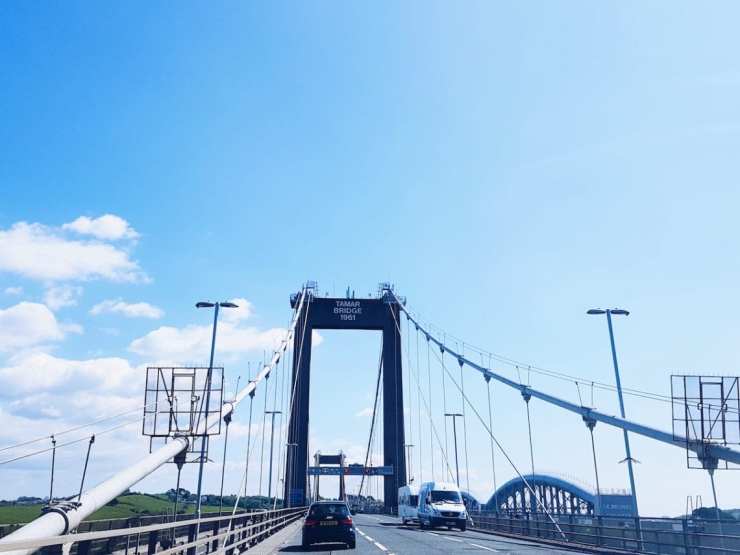
Tamar Bridge as we left Cornwall behind and entered Devon
2017-04-23 03.25.47 1.jpg
The countryside in Somerset
2017-04-23 03.25.47 2.jpg
Fields of Somerset
2017-04-23 02.20.23 2.jpg
Into Cheddar, a village where cheddar cheese is made. Watch out for Cheddar Gorge, which is the largest natural gorge in Britain, and which I have been wanting to climb for some time. 
2017-04-23 02.20.30 2.jpg
What do we see as we enter the village but a tractor rally.
2017-04-23 02.19.52 1.jpg
Forgive the smudges on the windscreen — the midges had a field day smashing themselves against it. But oh look at the towering cliffs above Cheddar.
2017-04-23 02.19.47 2 (1).jpg
If you are somewhere in Somerset, do not miss out on this.
2017-04-23 02.19.55 1.jpg
Rock climbing 
2017-04-23 02.20.01 1.jpg
While others were exploring the gorges, we decided to return another day because we had a long way to go home. Plus there were no parking spots left for us.
2017-04-23 02.20.29 1.jpg
Colours of the country
2017-04-23 02.35.51 2.jpg
Fields of Wraxall in North Somerset
2017-04-23 03.25.48 1.jpg
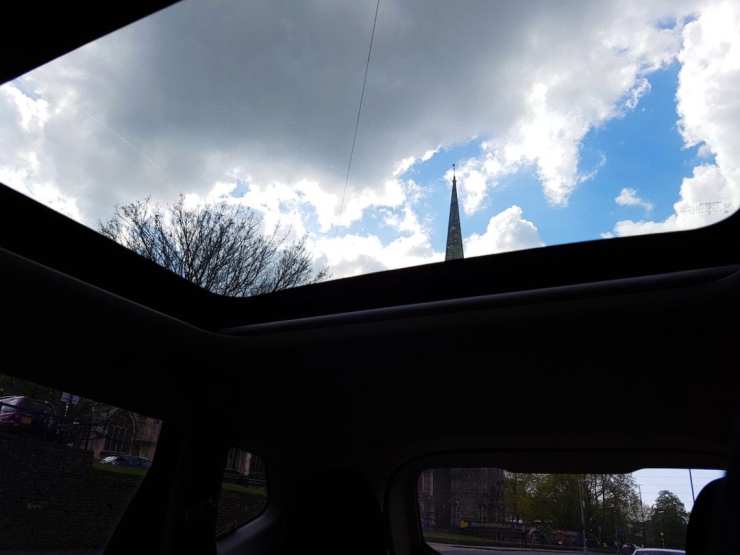
Clouds and church spires through the sunroof
2017-04-23 03.25.51 1.jpg
Trees, with leaves sprouting on them, raise their gnarled heads as we chase clouds above the houses of Bristol.
2017-04-24 03.02.05 1.jpg
Wandering into the Cotswolds
2017-04-24 03.02.03 1.jpg
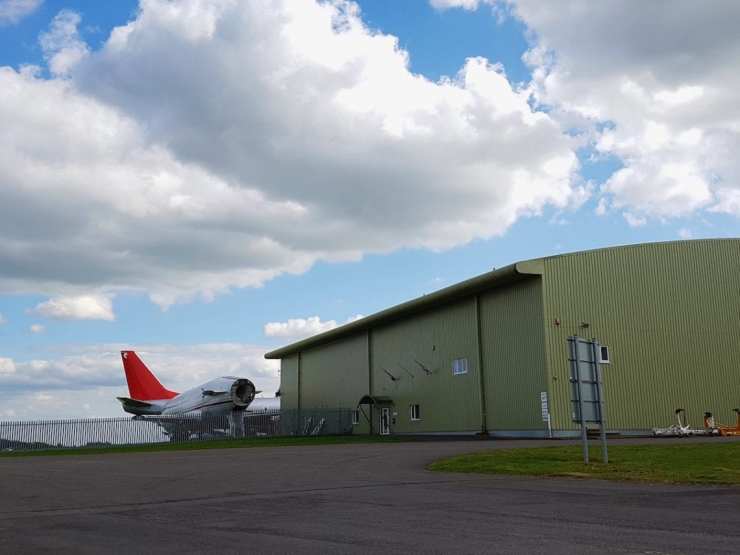
Because Adi had wanted to go into the Kemble Aerodrome for some time now
2017-04-24 03.02.00 1.jpg
A historic airport in Gloucestershire where some aircrafts apart, children and men race bikes 
2017-04-24 03.02.01 1.jpg
A last look at one of the smallest airports in the country


Dons of Padstow

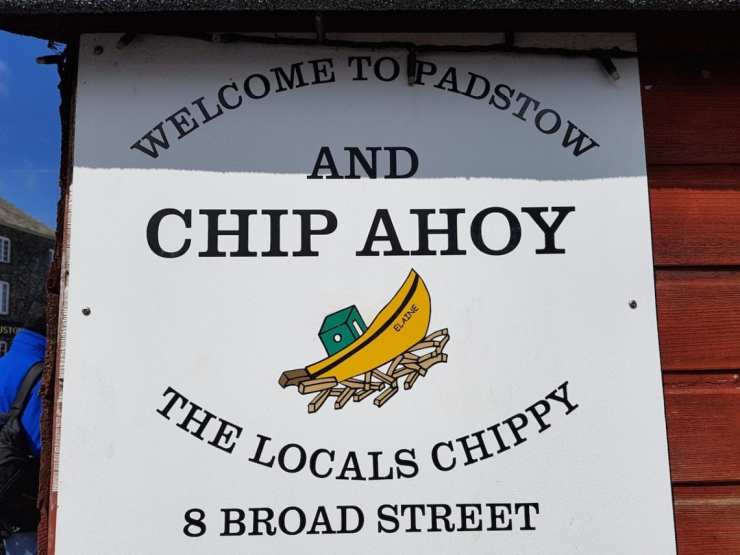
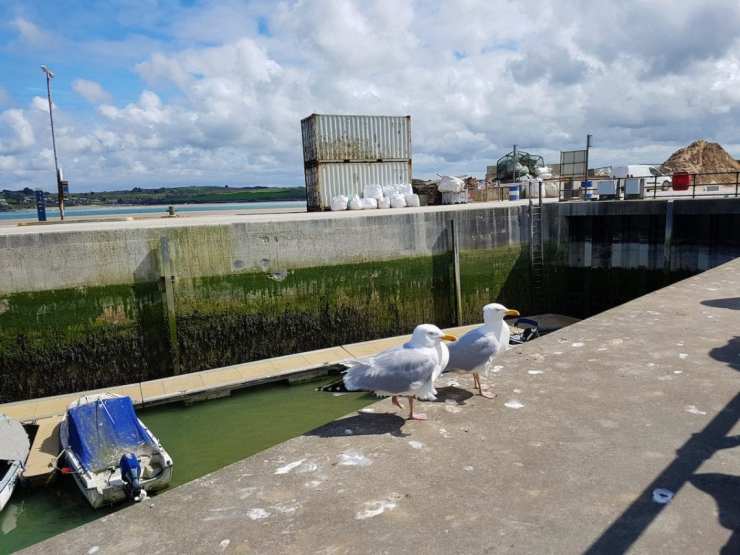
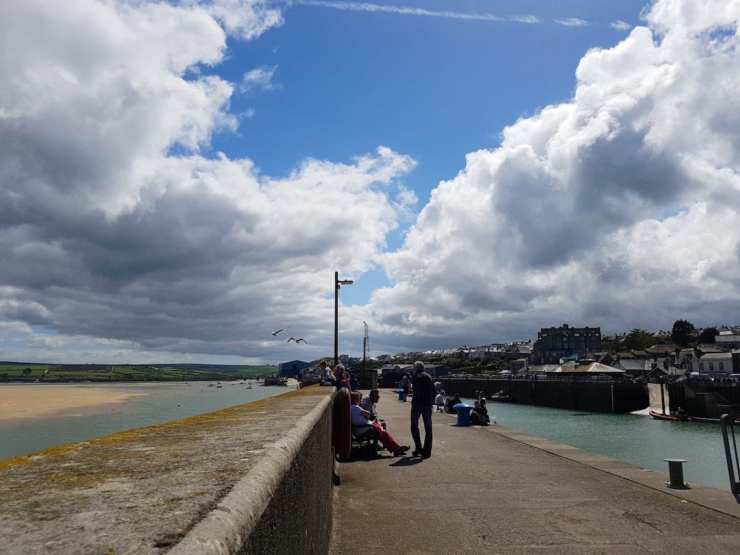
The gulls rule Padstow. Well, they rule the roost in most coastal villages, but in this north Cornish town they stomp across the road, stake their claim upon neglected morsels of food and they stand right above your head, swooping up and down till they have almost lifted off scalps, or some chips, please. I saw one gull fearlessly walk up to a man who was eating his fish and chips with the family by a chippy and make a go for some unforgotten chips lying on the ground. That brave man took him on. He cast gimlet eyes upon that gull, reached his foot out and stepped it firmly upon the chips. The gull turned around and strutted away across the road to the quay as nonchalantly as if he had never wanted it in the first go.

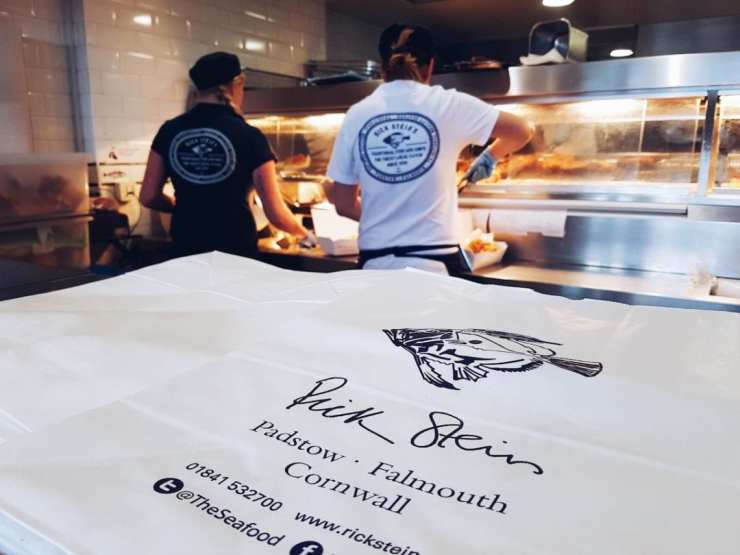
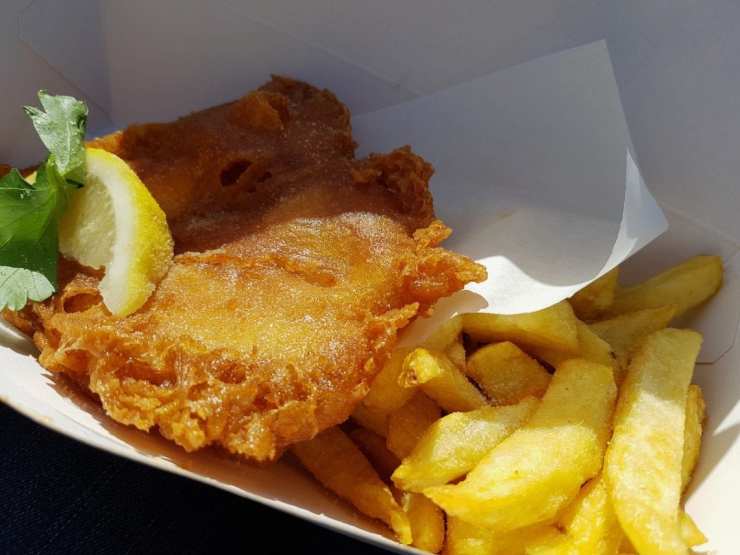
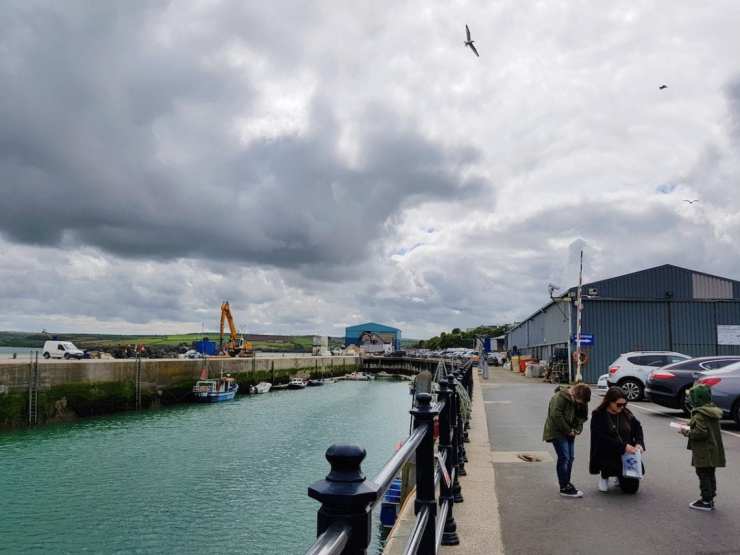
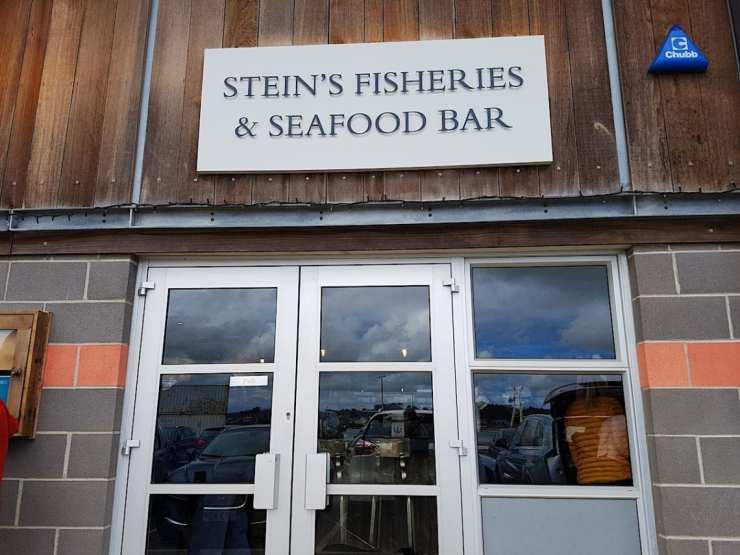
The other don of the fishing port of Padstow is Rick Stein. You know, the affable celebrity chef on telly who goes around cooking curries in India and tossing up spicy shrimps in Malaysia. Having read his memoir, Under a Mackerel Sky, I knew that he had started a mobile disco in Padstow, but walking into the streets of the port town, I realised that its nickname of ‘Padstein’ is well earned. It started from the parking lot that was packed to the gills. Right on it stood Stein’s chippy that had long queues of hungry people, waiting to attack their dose of fish and chips on a day of sunshine peppered up with rain clouds.

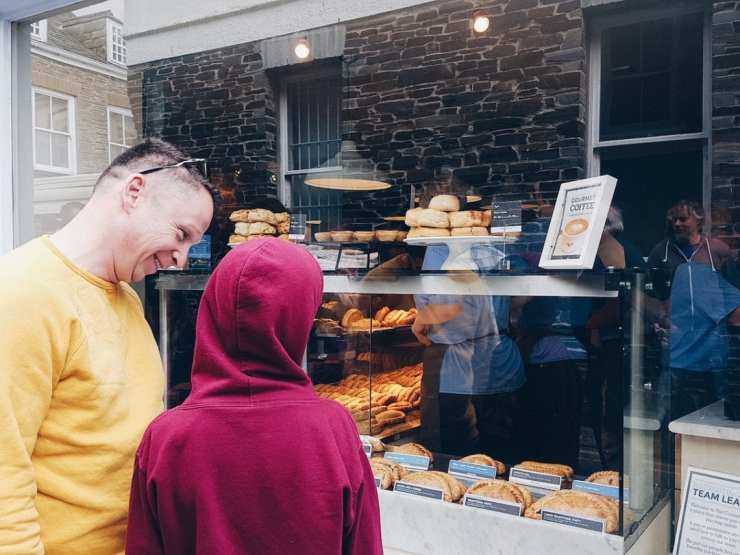
We were walking around in town and staring greedily at the pasty shops where massive pasties winked at us, waiting to be devoured. But no sir, Stein’s chippy it was because men could be overheard telling their sons to hold onto that ravenous appetite. It is a pity that we have but one stomach – it often makes me think that if there were a lottery held for extra stomachs, I would be right up front. Then there could be Both pasties and fish & chips for lunch.

We ended up at the Rick Stein chippy where the queue for a sit-down lunch was long enough to send us scuttling for takeaway boxes guzzled down by the quay. We joined the ranks of other fish & chips lovers, sat on the road by the car park, and were joined by two attentive gulls. Every time I turned my eyes warily behind me to check on their progress, they squawked in response, ‘Pass on some, you greedy buggers.’ Unfortunately for them, our booty was too delicious to part with. Plus I do not know if Stein would approve sharing his food with gulls. Also, you know this that feeding them is simply not a good idea.

If you have quiet villages in Cornwall, you have fishing port towns too like Padstow which are bustling with life, buskers and little girls with ringlets dancing to their crooning, yellow trawlers whisking you across to villages across the waters, bookshops selling beautiful tomes, antique stores and vintage decor stores, ice cream vans because people are always eating on holiday. Fish & chips over? Time for some Kelly’s full-fat ice creams.

Processed with VSCO with  preset

2017-04-18 08.56.56 2.jpg

2017-04-18 08.56.43 1.jpg

2017-04-18 08.56.40 1.jpg

2017-04-18 08.56.41 1.jpg

2017-04-18 08.56.39 1.jpg
The attentive two
Processed with VSCO with  preset
The car park and the barn on the right where Stein’s chippy is

2017-04-18 08.56.44 1.jpg

2017-04-18 08.56.45 2.jpg
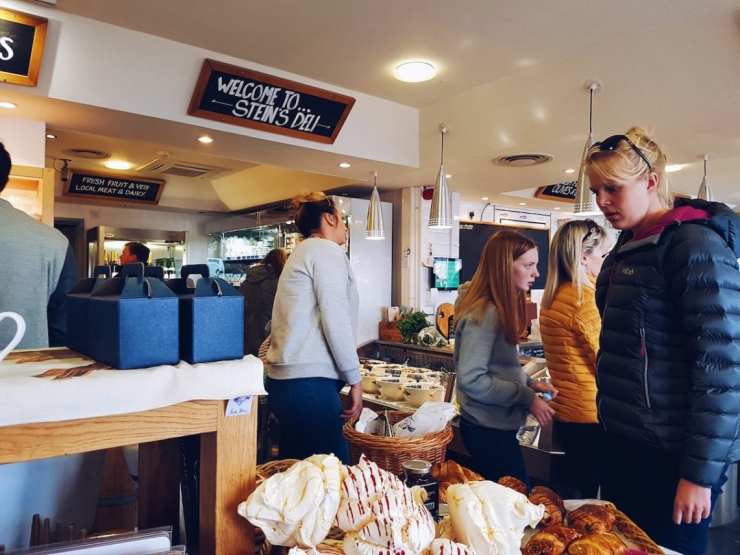
The deli where everything screams to be owned
2017-04-18 08.36.08 1.jpg
Padstow has been a bustling fishing port since the times of Elizabeth I. I wonder about her reaction if she had seen it today. You think she would have plumped up her massive hooped skirts and sat down for fish and chips by the waters, braving the gulls?
2017-04-18 08.35.59 1.jpg
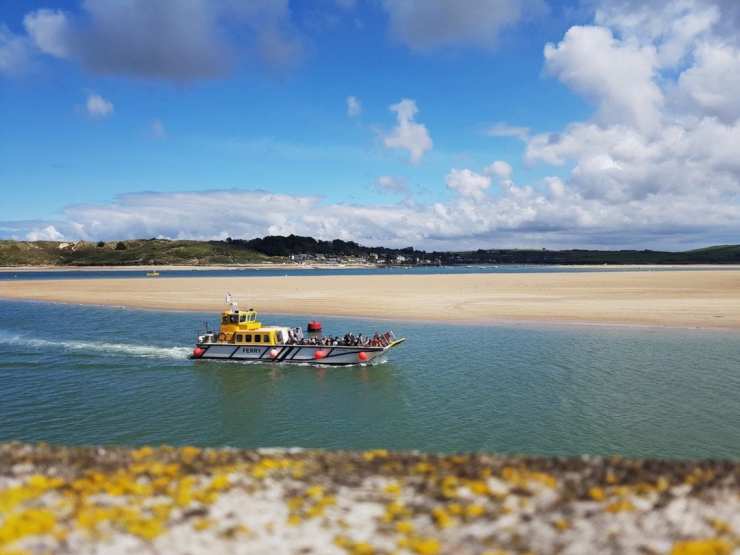
That Doom Bar, the sandbank that is, has caused some 600-odd shipwrecks for more than 200 years. The legend goes that a merry mermaid, who liked watching the vessels coming in and leaving Padstow, was shot by a sailor. She cursed the harbour with desolation as a result of which a storm is supposed to have materialised and the sandbank thrown up subsequently. Across it is the Rock, a village that is a favourite with the London crowd.
2017-04-18 08.36.22 1.jpg
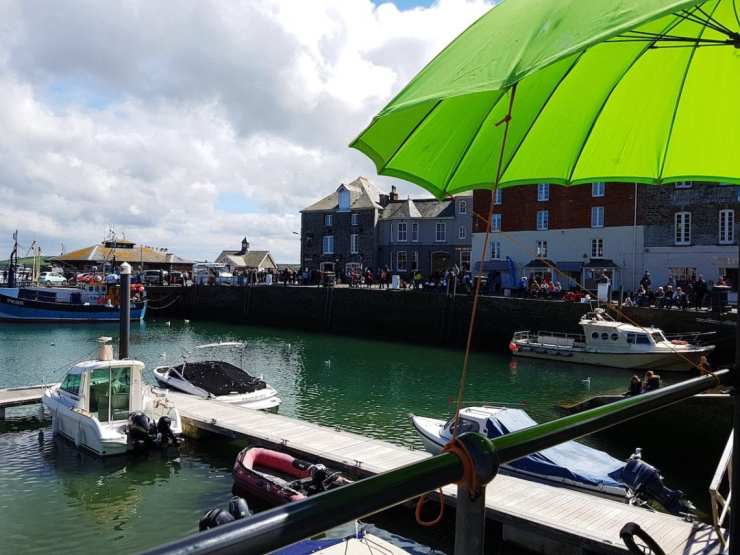
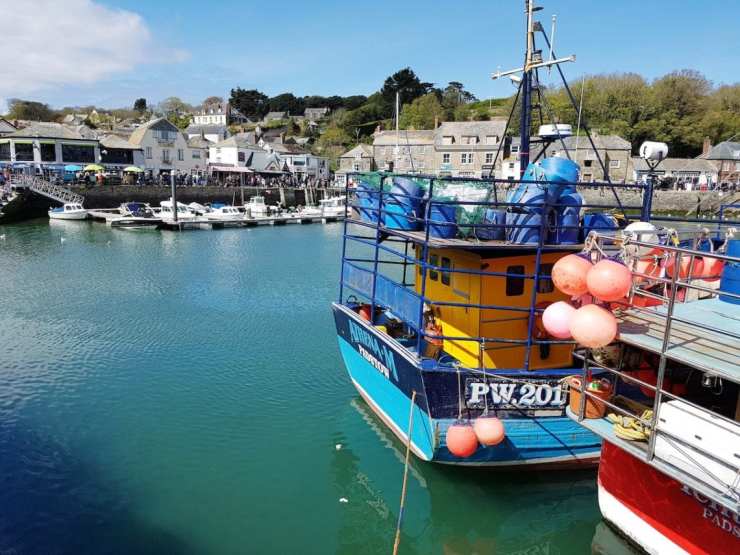
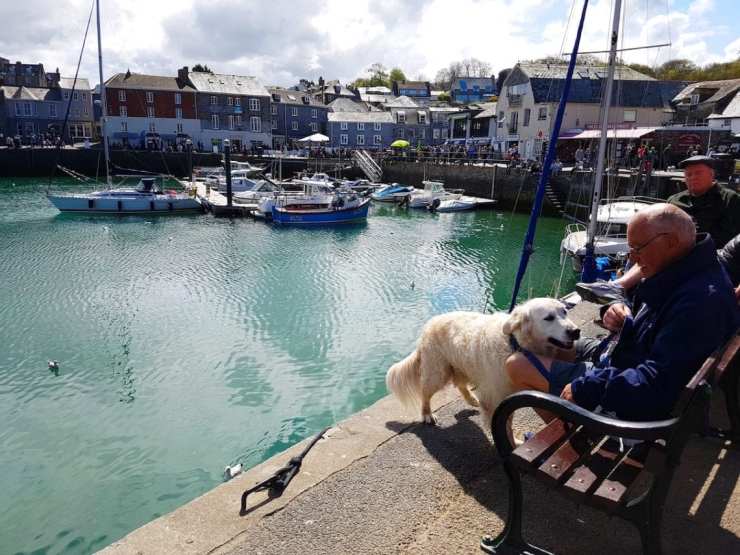
Padstow’s delightful harbour
2017-04-18 08.36.18 1.jpg
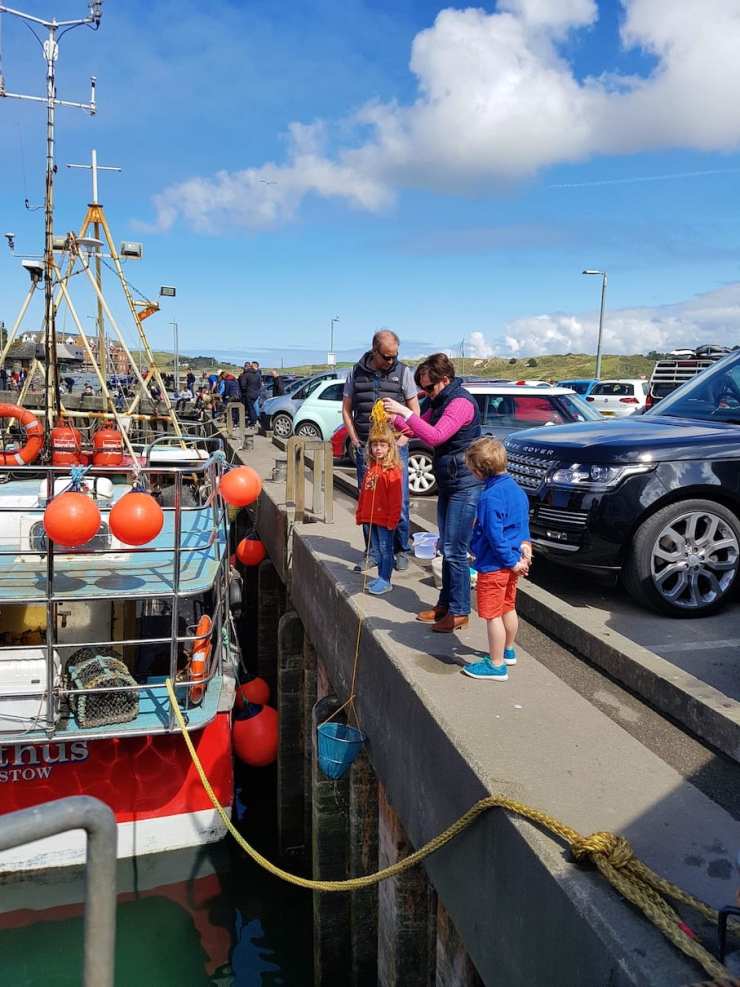
Crabbing
2017-04-18 08.36.00 1.jpg
‘Ferries to the Rock,’ he boomed into the beautiful noon
2017-04-18 08.35.58 2 (1).jpg
Along the Doom Bar
2017-04-18 08.35.51 1.jpg
Doggie haven. Dog stalking became easier with all shapes and sizes to choose from. Golden retrievers are my favoured kind.
2017-04-18 08.36.16 1.jpg
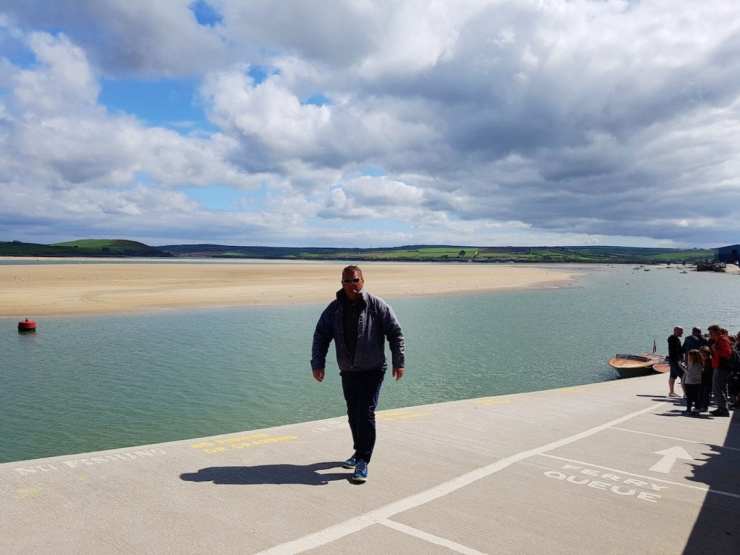
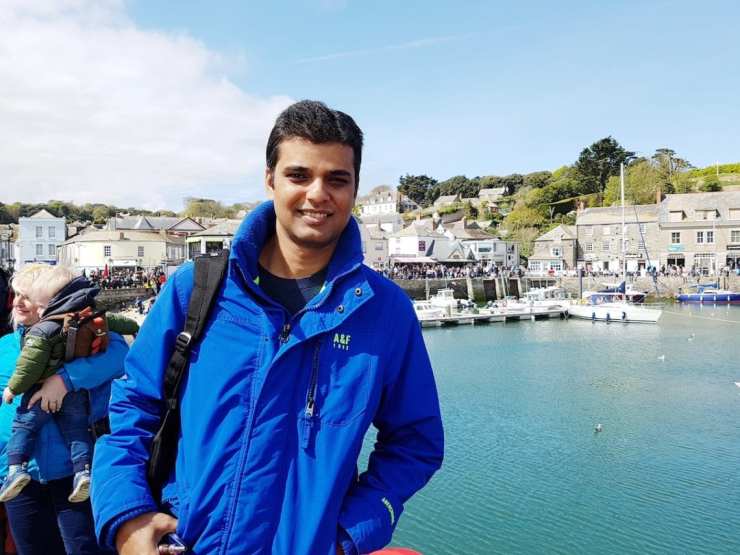
The man and Padstow
2017-04-18 08.35.48 1.jpg
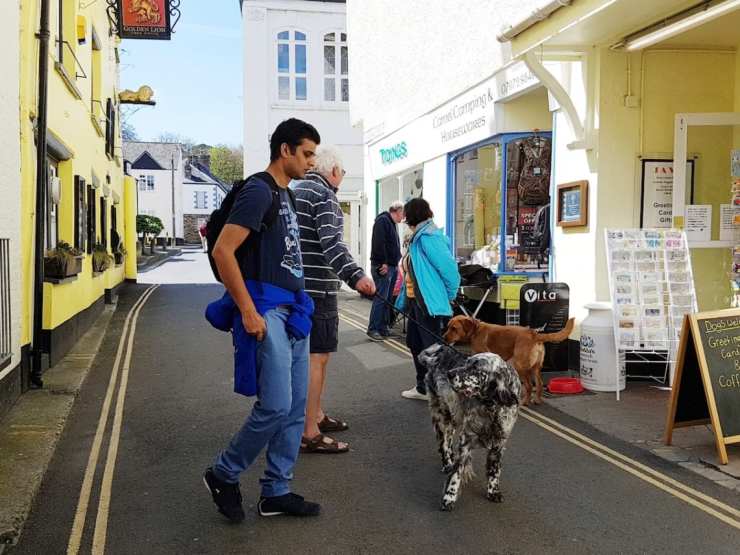
When Maximus, the English Setter, slobbered all over Adi’s trousers.

2017-04-18 08.35.40 1.jpg

2017-04-18 08.35.37 1.jpg
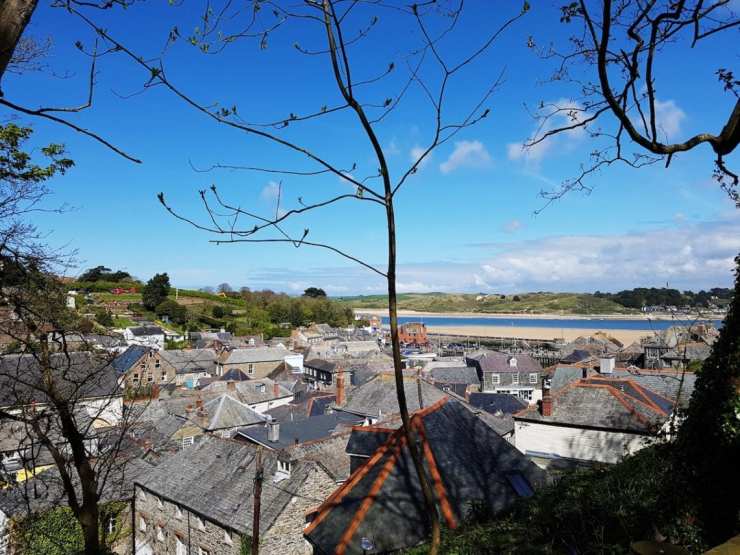
An overview of Padstow. In the distance you can see the red air ambulance which is called in during emergencies in Cornwall.

How to Get There:

It takes around 5 hours to get to Padstow from London. Take the M4 to Bristol, head south on the M5 to Exeter and then follow the A-roads to Cornwall. Of course, you own a GPS, so I shall not blather on.

Where to Stay:

The Old Ship Hotel (www.oldshiphotel-padstow.co.uk) is an old, listed property to which most people also flock for some pub grub. Book way ahead for your summer holidays.

Rick Stein’s Café (www.rickstein.com) which apart from offering lovely breakfasts also offers rooms which you would be loathe to leave. They have been designed by Jill Stein,

Where to Eat:

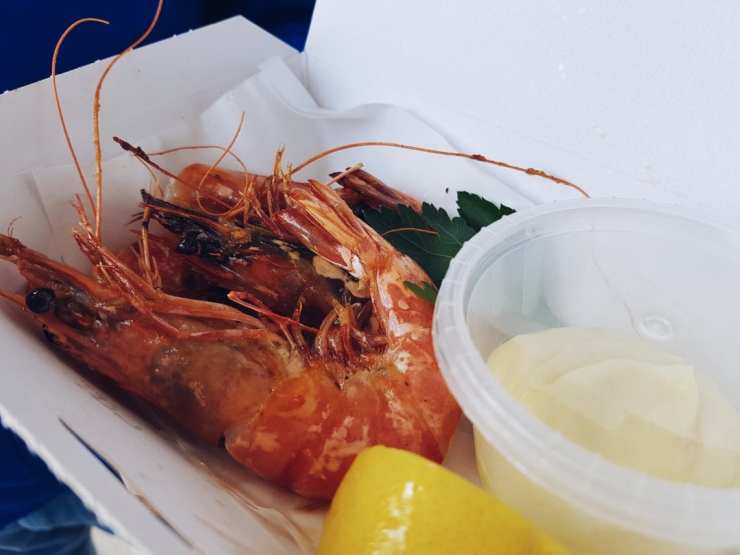
Prawn on the Lawn (www.prawnonthelawn.com)Seafood that is as fresh as fresh gets in this fishmonger and restaurant which gets its catch from boats that ply the waters around Devon and Cornwall. Along with starters and mains, you would pay around £35 per person.However, if you choose items such as Prawns on the Lawn Fruit de Mer it would cost you £70 straightaway.

Rick Stein’s Chippy (www.rickstein.com) overlooking the Camel Estuary offers fairly reasonable fish and chips which is priced at roughly £7 per person.

What to Do:

National Lobster Hatchery for an idea about the conservation of fishing traditions in Cornwall.

Take the ferry to Rock.

Hire a bike and cycle along the Camel Trail which runs for 5 miles along a disused railway track. Great for bird watchers because the Pinkson Creek that you pass by is a favourite with curlews and egrets among other species of birds.


Meeting Alastair in Polruan

I am a glutton, yes, as all of you know by now, and unashamedly so. But the lead photo is naught to do with my glutton genes. The point of the photo is that apart from emphasising our love for fish and chips on holidays (let’s get fat fast), in the background is Alastair.

After our walk in the Cornish Woods we fell upon our plates with ravenous appetites, eyes goggling at the sight of food. Hours of walking through the woods and sudden steep stretches can do that to you. A middle-aged man with a shock of white hair entered the pub through its dwarfish door and asked for a half-pint of ale. Thereafter his natter did not cease. The barmaid lent her ears till she naturally had to serve other customers. At this point he turned around, spoke a few words to a girl in a pram, then turned our way and asked, “Have you guys come down from London?” That was the beginning.

These are the encounters that make a trip worth its salt. Do you know what I mean? Of course, you do. We are all social beings. Somewhere deep inside, even the most introverted individual likes to meet people. This yearning is engraved into the human genome, irrespective of caste, creed, age, gender. That apart, meeting new individuals is our window into a different kind of life; it may often be the life we aspire to.

Alastair gave me hope, that dreams do come true. But you cannot sit back, lie on your couch, and have visions of this glory that should have been yours. You work towards it. Listen to his story?

Alastair spent a fair part of his childhood visiting Cornwall with his parents. He roamed the world, said he never found anything like Cornwall.

A London worker, he came to Polruan one day, three years ago, and started looking for bed & breakfast accommodations. Found none, slept on a bench overnight with his rucksack and liked the look of the village so that he met an estate agent to scout for a cottage to buy. He found one at the top of the pub we were sitting in, that is the Russell Inn, and he staked his claim on it. But that is never enough, as we all know. We have got to go through the miserable practicalities of life such as waiting, negotiating, and the works. The estate agent would give him a call if it worked out.

He returned to daily routine in London and thought nothing would come of it. Two weeks had passed when he got a call from the estate agent, asking him to pop down to Polruan, sign some papers and take the cottage off his hands. That is how Alastair found himself back in the village with two bags and a rucksack. He lay down his sleeping bag on the floor of his new home because he had nothing apart from those few bags and slept. He woke up to a new life of a small pension, but it was also the life he had yearned for during his growing-up years.

Then Alastair muttered a few dozen ‘sorry’s’ for interrupting our meal (what would the Englishman be without them) and asked us to return for a pint with him at the pub. “I live up this hill,” he added. I do not know if we will end up sharing more conversations over a pint, yet for those few moments Alastair gave us a window into a future which seems achievable.

When you walk into Polruan, you see why Alastair fell for it. We did as easily.

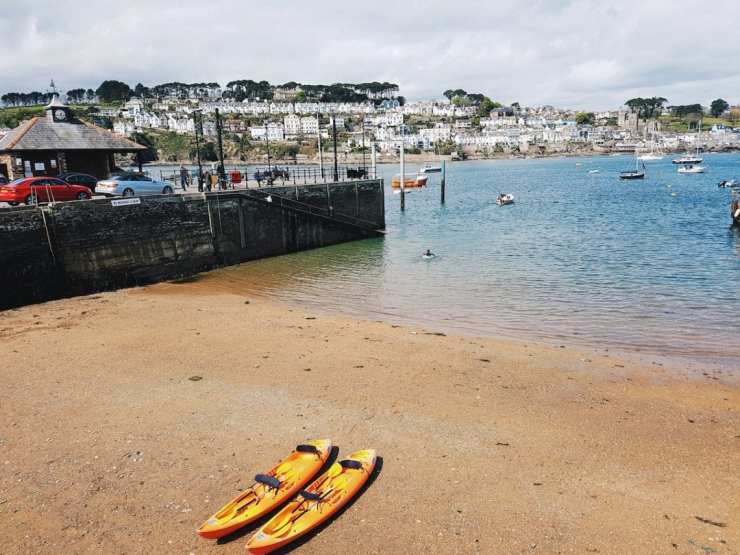
Cornish fishing villages are a cut above anything you’ve seen. This particular one is stationed by the river Fowey with one road leading in and out of the village, names like ‘The Singing Kettle’, ‘Lugger Inn’ and ‘The Winkle Picker’ winking back at you. There are two pubs in the village – the 19th century Russell Inn (where we sat) and the old Lugger Inn. The Winkle Picker is a convenience store-cum-post-office that gets its name from its previous owners. The two misses were called Joan Winkle and Joanne Pickering, so you have that cute outpost on the quay.

2017-04-15 07.38.40 1.jpg
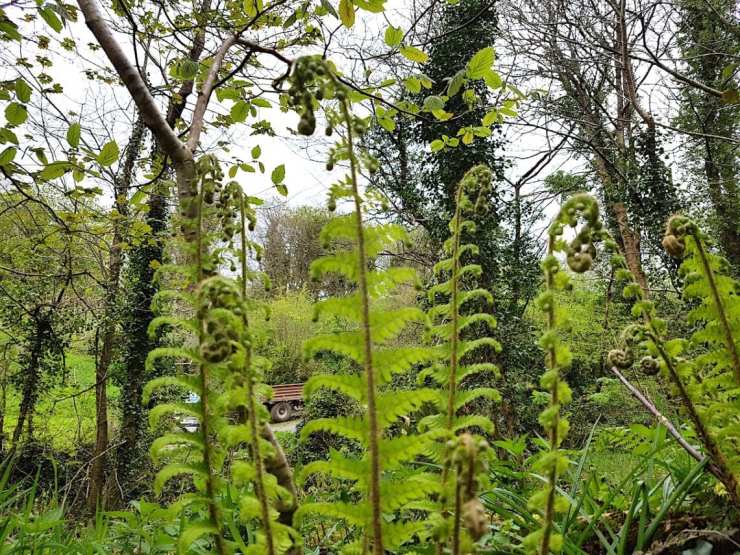
Curled-up ferns in Lanteglos-by-Fowey. The final leg of the walk, before we reached Polruan.
2017-04-17 07.33.01 1.jpg
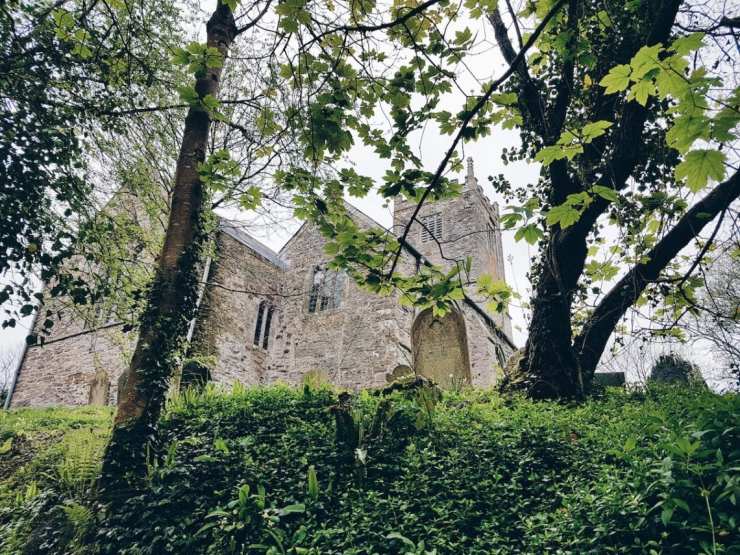
A 14th-century church that loomed up above us at the end of the walk
2017-04-15 07.38.39 1.jpg
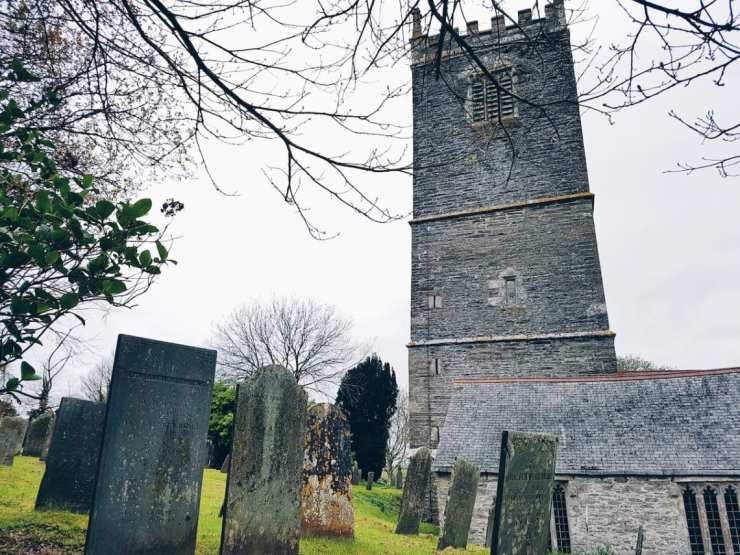
Lanteglos Church with many Victorian graves, those of soldiers who died during WWI and of some who died of sweating sickness in the 15th century.
2017-04-15 07.38.36 1.jpg
Solemn sheep-y stares
2017-04-15 07.38.38 1.jpg
Other variety of solemn stares
2017-04-15 07.38.35 1.jpg
Patched network of Cornish country. The grey clouds dispersed and gave way to blue skies as we entered Polruan.
2017-04-15 08.21.30 1.jpg
The one village street that leads in and out of Polruan.
2017-04-15 08.21.25 1.jpg
Russell Inn, one of the two pubs in the village.
2017-04-16 09.54.33 1.jpg
The other pub in the village
2017-04-16 09.54.34 1.jpg
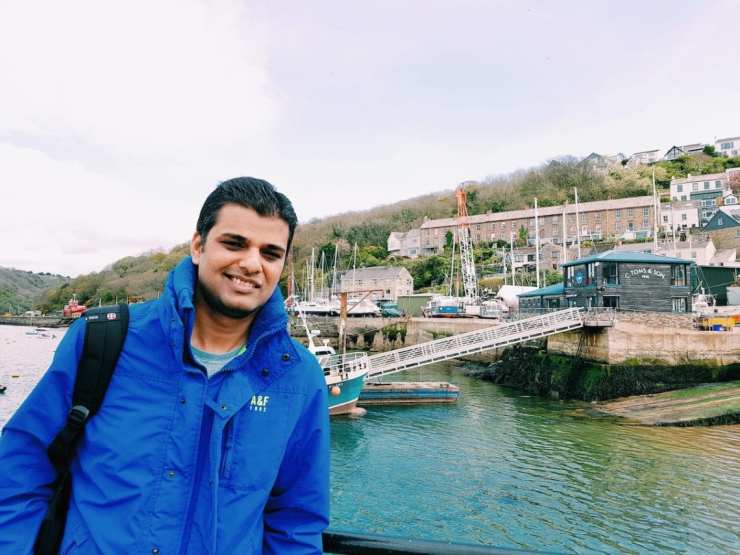
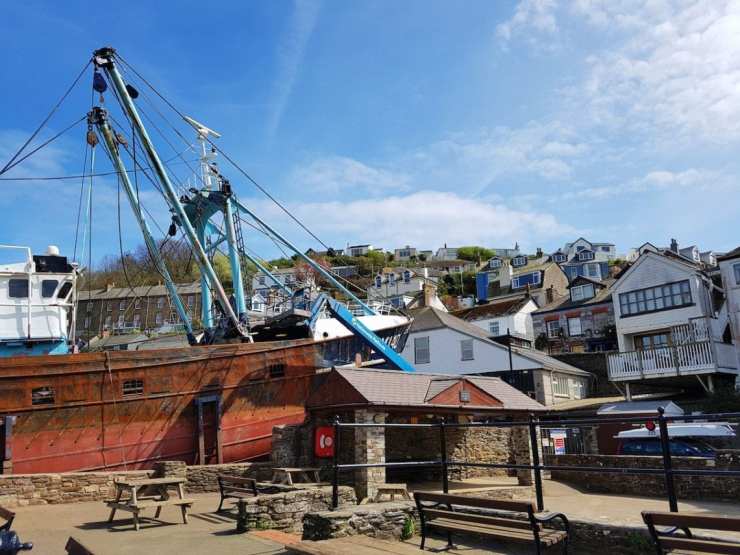
Polruan harbour

2017-04-16 09.54.41 1.jpg

2017-04-16 09.54.33 2.jpg
Boat repairs in motion

2017-04-16 09.54.36 1.jpg

2017-04-15 08.21.31 1.jpg

2017-04-16 09.54.40 1.jpg

2017-04-16 03.30.54 1.jpg

How to Get There: Get to Fowey and take a 5-minute ferry to Polruan.

Where to Stay: At the top of the village, is a Polruan Holidays campsite (www.polruanholidays.co.uk) with 40 pitching spots. The view from the campsite: Stunning.

If not that, go for Hormond House (www.hormondhouse.com) where they have just three rooms, so book ahead?

What to Do:

St. Saviours Chapel, an 8th century church.

Brazen Island, an isolated rock.

Ferryside (Daphne du Maurier’s home) and Bodinnick.

The Hall Walk in the heart of Daphne du Maurier country takes you through Bodinnick, Lanteglos-by-Fowey and Polruan.

A Walk in the Cornish Woods

I am knackered and I have a suspicion. I am on my way to turning into a hefty Cornish cow. A thought fuelled by a steady two-day diet of scones, pasties, tarts, full-fat ice creams, butter biscuits and onion rings. Is it possible that the waistband of the jeans can scream out for temperance within a short span of time? These are grave times.

The scoffing has been going especially strong after steep climbs through woods in the heart of Daphne du Maurier country. Our walk started in the fishing village of Bodinnick where the author of Rebecca lived with her mother and sisters – after they had left behind their home in London. Ferryside is a pretty cottage, blue pipings framing its doors and windows. What a view young Daphne must have had. The turquoise waters of the river that acquire emerald tones even when the skies are overcast. Daphne’s son lives in Ferryside. I did have thoughts of knocking upon his door – suitably alarming Adi who since then started thinking about paths to take on the return and how not to walk past the cottage again.

A two-second ferry from Fowey took us into Bodinnick where we climbed steep roads past Daphne’s cottage, and then a row of rustic white, blue and yellow cottages, the doors of which had Easter egg wreaths in keeping with the seasonal cheer.

During walks in the English countryside, you inevitably get directions that ask you to proceed past old school houses, and that right lane there past the pub, then a kissing gate in the field and further in continue through the church gates. Or cross Two-Turn Lane past the sheep that guards the gate into its grassy knoll of heaven… you get the drift. The directions are as old-fashioned as the villages you find yourself in. Like a time bubble. Once you make it past these stellar signposts into the woods, you strike gold. If you have not made it to those landmarks, my friend, you are doing it all wrong. You are probably in another country.

2017-04-15 07.39.03 1.jpg
Fowey

2017-04-15 07.39.01 1.jpg2017-04-15 07.38.55 1.jpg

2017-04-15 07.38.52 1.jpg
The inn that Daphne du Maurier must have seen when she came into the village in the 1920s to move into her new home.
2017-04-15 07.38.49 1.jpg
The climb gets steep in Bodinnick once you are off the ferry

2017-04-15 07.38.50 1.jpg2017-04-15 07.38.48 1.jpg

2017-04-15 07.38.45 1.jpg
Views from the woods above Bodinnick
2017-04-15 07.38.41 1.jpg
Abandoned water mills near Polruan

I shall have to continue this into the next post because I can barely keep my eyes open. But I have to say this that the skies outside at this time of the night are speckled with stars. The early morning glum clouds gave way during the course of the noon to a clear firmament so spotless that the stars have declared that the inky dome is theirs. Life should be just so. Lived beneath vast swathes of sky unfettered by the trammel of city lights, busy dreams and the worry of tomorrow.


Frisky Border Collies and Cornish Byres

The weekend has started on a yellow note in the early hours of the morning. Getting up at 4am and witnessing dawn is Early for me. My father would faint (with delight) if he saw such changes in a daughter who has always nursed a penchant for sleeping like Kumbhakarna. Who might you ask, with a frown? K is a rakshasa straight out of the Indian epic Ramayana. If you have not heard of him, he is part of a saga that runs through the ream of bedtime stories reserved for every Indian child. A rakshasa is a man-eater. What I have in common with K, I am relieved to say, is just a passion for sleep. He used to shut eye for 6 months at a stretch – nothing could rouse him – and the legend will have you know that his snores could send tremors through the belly of the earth. When he did wake up, K would devour every living creature within his line of vision.

Post sessions of heavy partying on Saturday nights in Delhi, I would wake up on Sunday well past midday. I was the only young individual in an old building, its exteriors peeling off with the years since partition when the landlord’s family had moved in as refugees. The other occupants were a family of three on another level. The latter colluded with my parents (when they would visit me from Calcutta) to get me married off. A girl in her mid-20s living on her own and single is the neighbour’s alarm. The wife would often bang on my door to deliver the food she had cooked (which was extremely sweet but a bit of a test for someone nursing a ferocious hangover almost every weekend). This was followed by incessant banging on the door by the cleaning lady. She indulged in it with as impressive a ferocity as the hangover and, Saroja, I am convinced, enjoyed this routine. So there I was, your quintessential Kumbhakarna.

That is but the long and short of it.

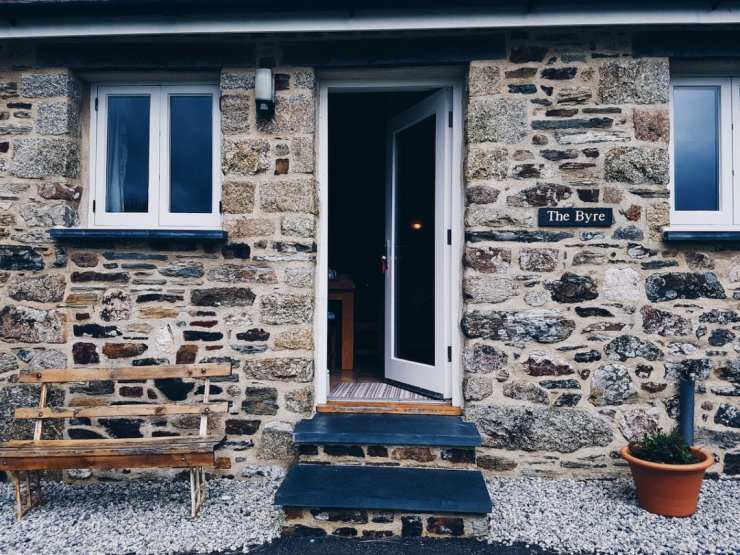
Back to my lush surroundings in the Cornish wooded valley of Lostwithiel where we are staying for the long weekend, with a few extra days bunged in. I stood with my back to the door of our byre – old English for cowshed – busy loading up the fridge with our haul of groceries, when a huff and a puff and then patters on the flagstone floors startled me into a low scream. I almost felt back upon an enthusiastic border collie called Meg.

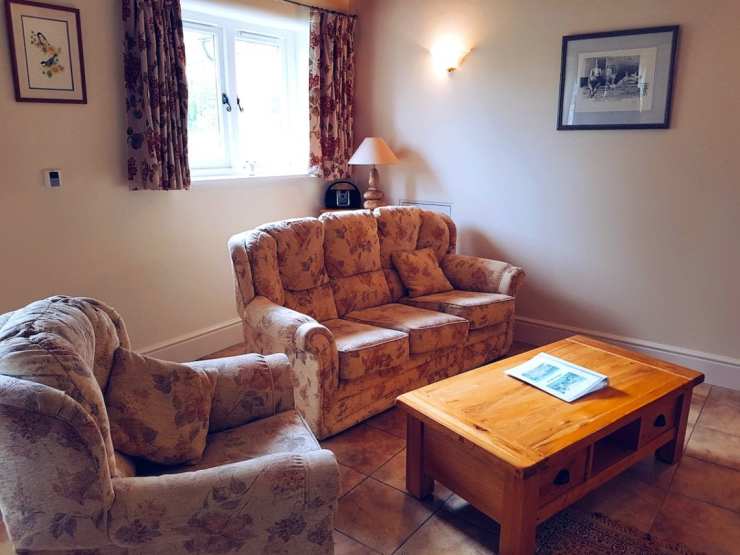
We had just arrived at the byre, a converted detached accommodation at a farm.

The strange dog turned over. I decided to do what I do when a four-legged boy/girl does that. Administer vigorous belly rubs till she had stopped whining and cooing, ‘Ooh yeah, don’t stop!’

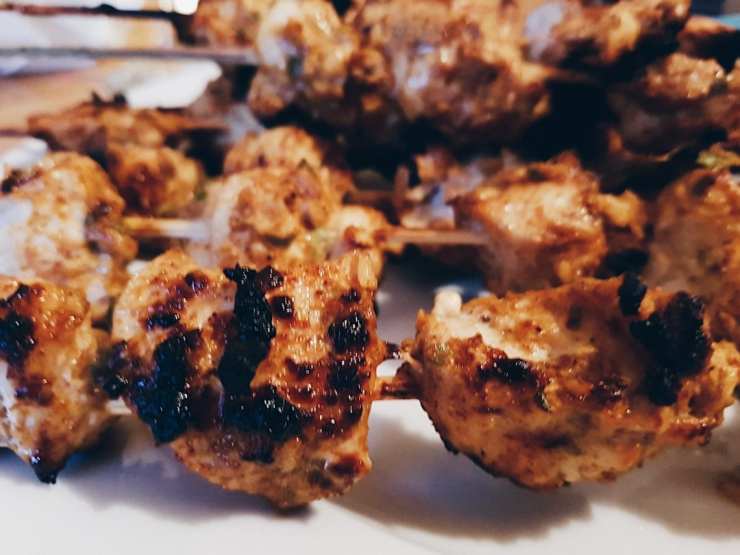
A bit abrupt but the succulent chicken kebabs barbecued by Adi have just arrived on the table and I think I shall have to abandon this incessant chatter. Bless Adi for saving you from all of that.

Unknown.jpeg
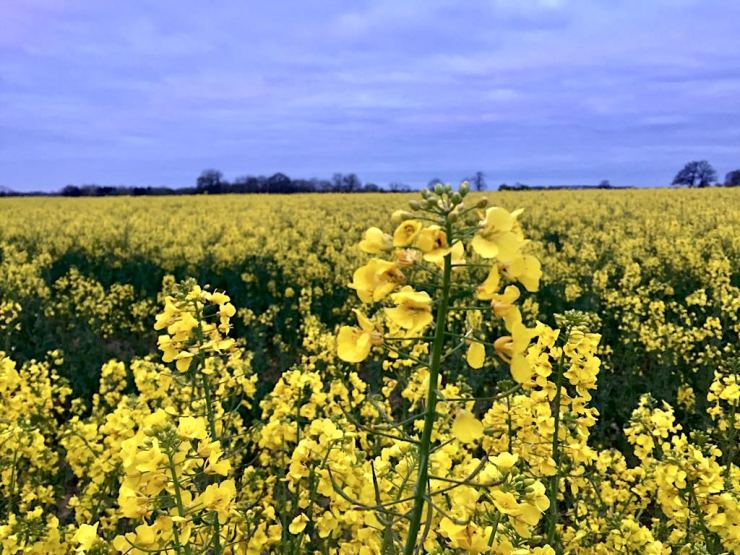
Rapeseed fields in the Cotswolds as dawn breaks over a silent countryside. Courtesy: Aditya Varma
Processed with VSCO with  preset
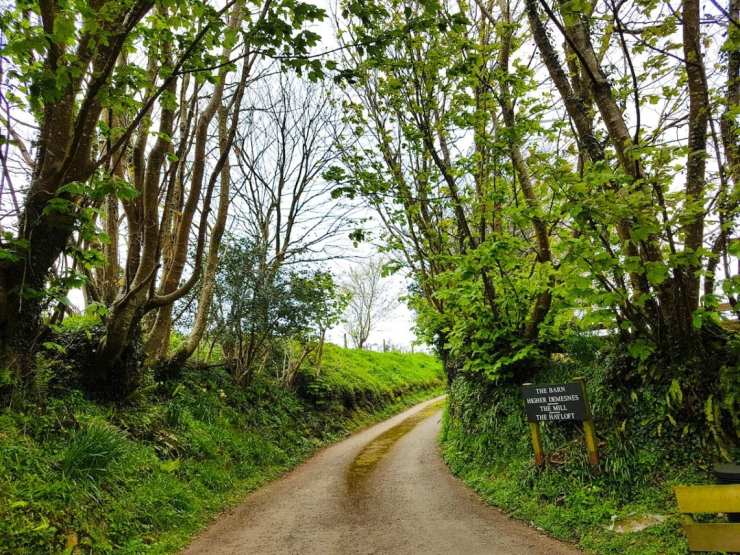
Searching for the byre in Lostwithiel
Processed with VSCO with  preset
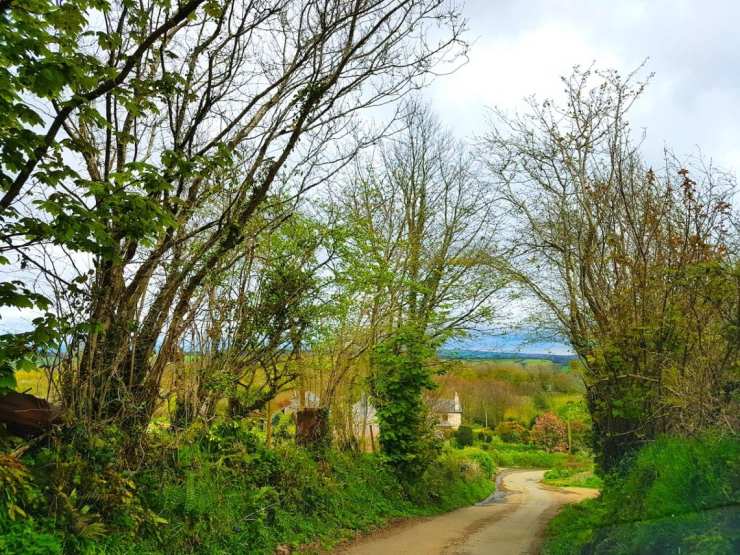
Wooded valleys of Lostwithiel
2017-04-14 05.21.44 1.jpg
Our nest for the next week
Processed with VSCO with a5 preset
Snuggling can be a serious preoccupation
Processed with VSCO with hb1 preset
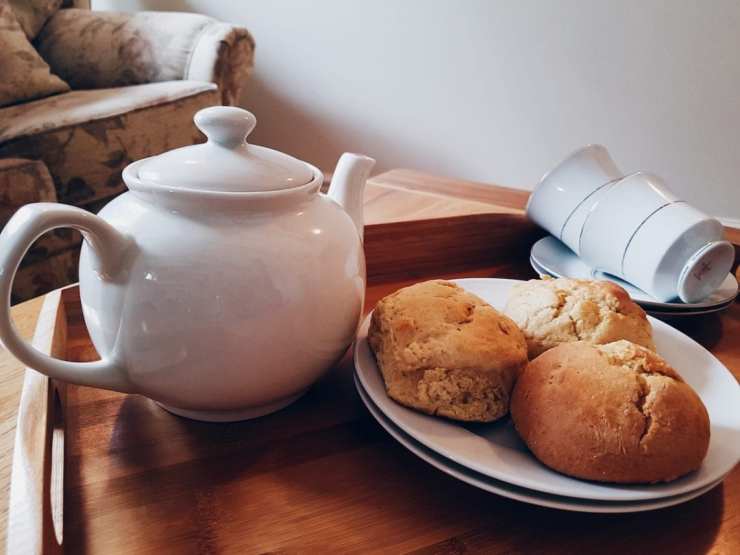
Cream tea put out thoughtfully by Ed and his wife
Processed with VSCO with a5 preset
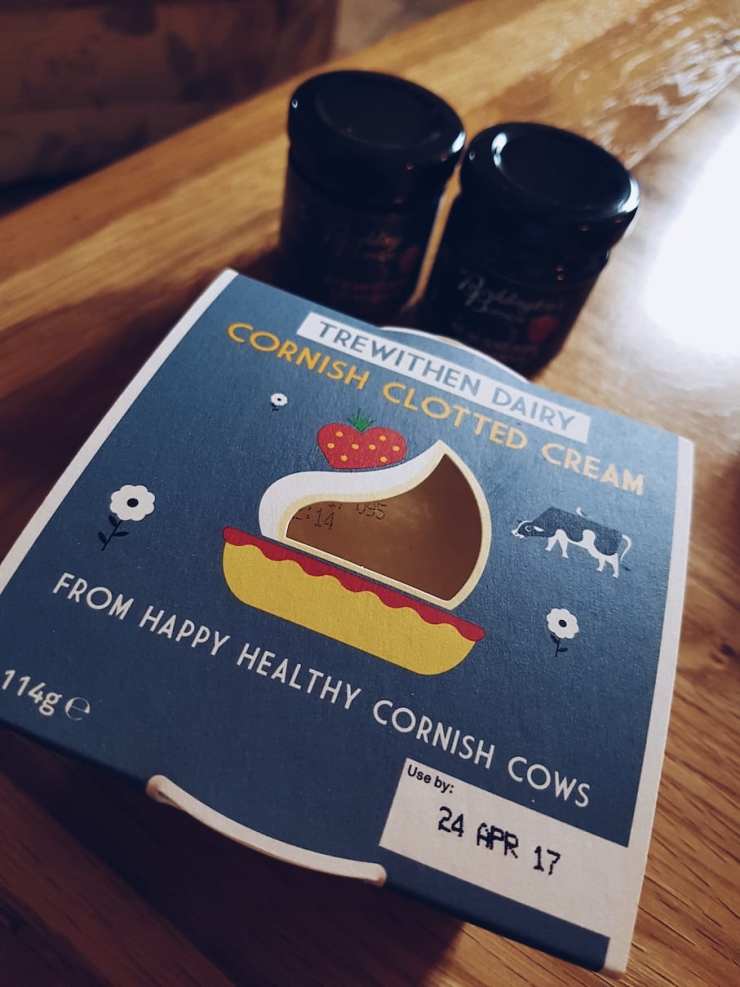
Clotted cream without blackberry & strawberry preserves made in-house? Good heavens!
2017-04-14 06.17.53 1.jpg
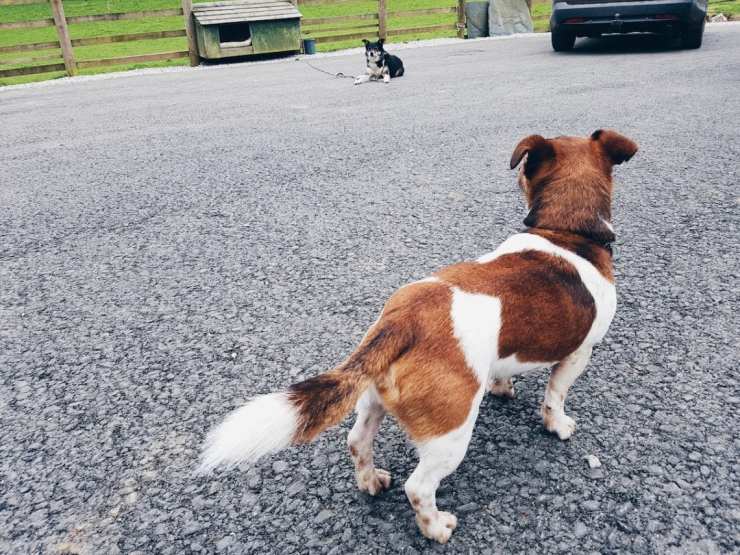
Meg and Gizzie (the Jack Russell terrier in the foreground) 
2017-04-14 08.34.09 1.jpg
Adi’s smoky, spicy handiwork for this nippy evening along with some jacket potatoes. Bliss.

Till tomorrow then, toodles.

Up and Down the Yorkshire Dales

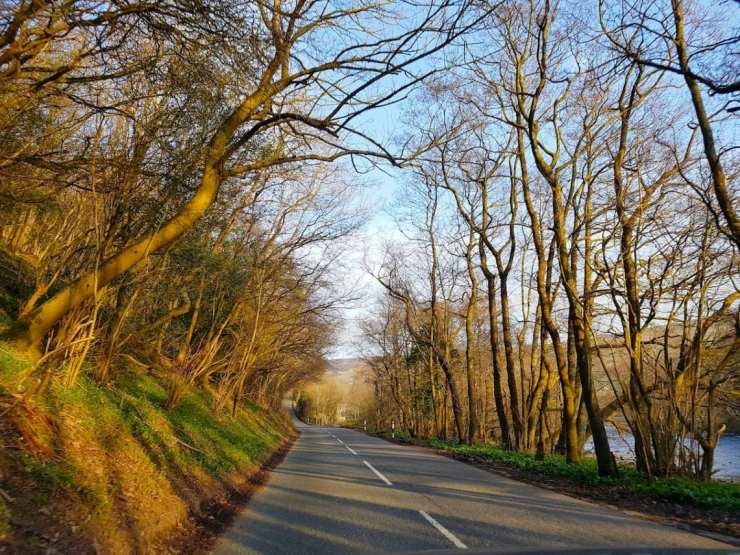
The countryside has zero pretensions. None of the glitz, glamour, competitiveness or fatuous claims that is part of our daily lives are to be found in the country – unless you are a recluse who is pretty much done with the frivolities of life, and have therefore retired in the bosom of the country, where your life is about communion with nature. Nature is insidious, isn’t she? She will make her way into your heart with sheer smoothness. Each country escape is a reinforcement of that thought.

We met an old couple at a tearoom in the village of Muker after the long walk to Crackpot Hall. The man was the spitting image of Ian McKellen (remember him? ‘Magneto’, ‘Gandalf the Grey’…). When he turned around, I almost said out loud, “Gandalf!” I did not however do that. It is not alright to unleash your wonkiness on poor, unsuspecting people who have just met you.

Nattering away is the best thing you can do during tea time. So there we were finding out nuggets about each other – stranger couples exchanging life stories. It turned out that Gandalf and his wife were hardcore Londoners. Forty years ago, they moved to the Yorkshire Dales. His grudge was against Americans (come on, don’t get grumpy all over me, I am just the purveyor of conversations) invading the city. “The day the Americans came in and they stopped doing beer for lunch, I knew it was time for us to leave London,” he said.

The British have their priorities in place. You cannot fault them on that.

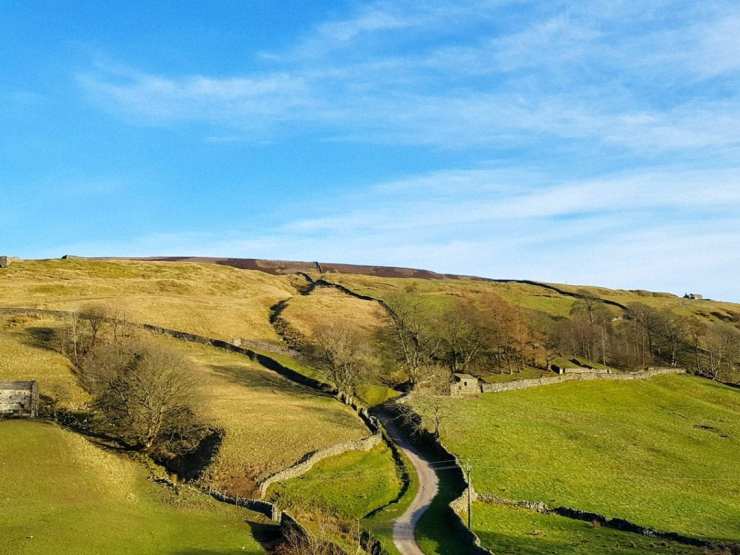
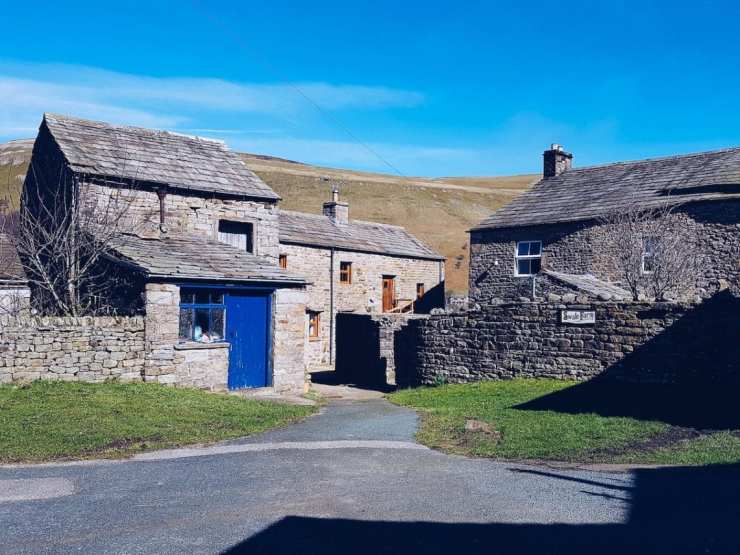
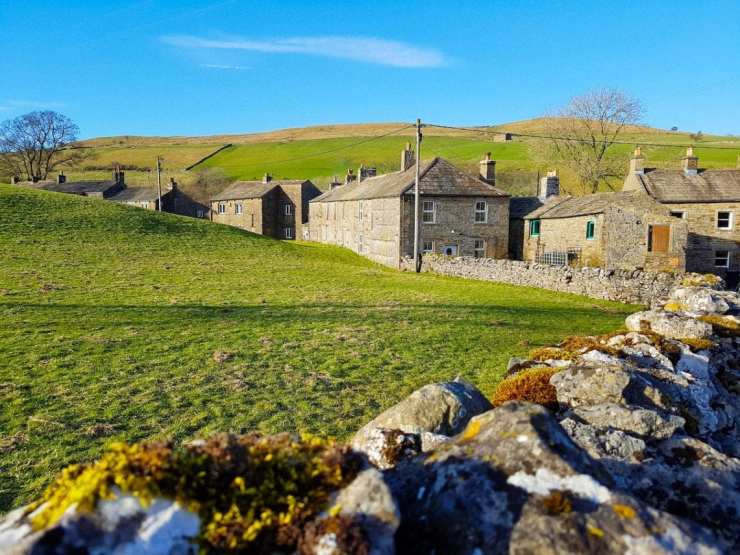
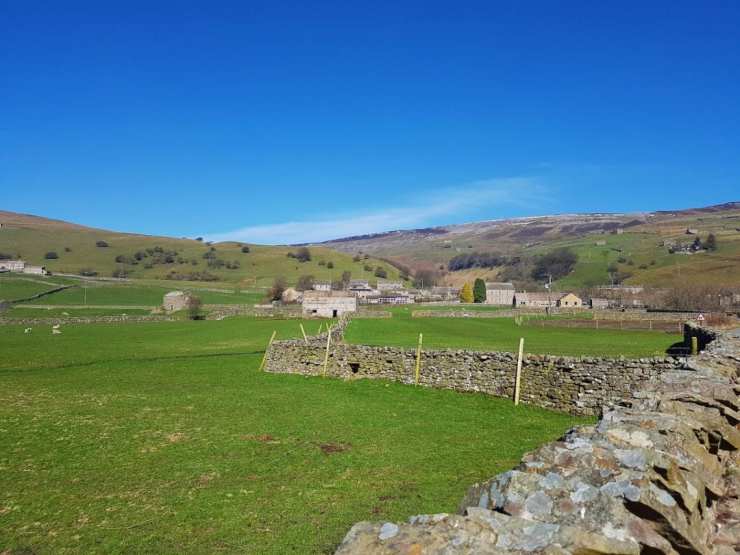
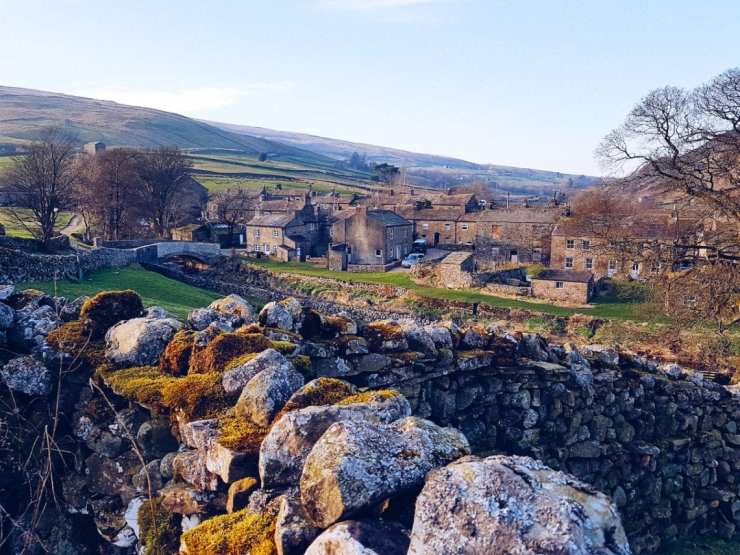
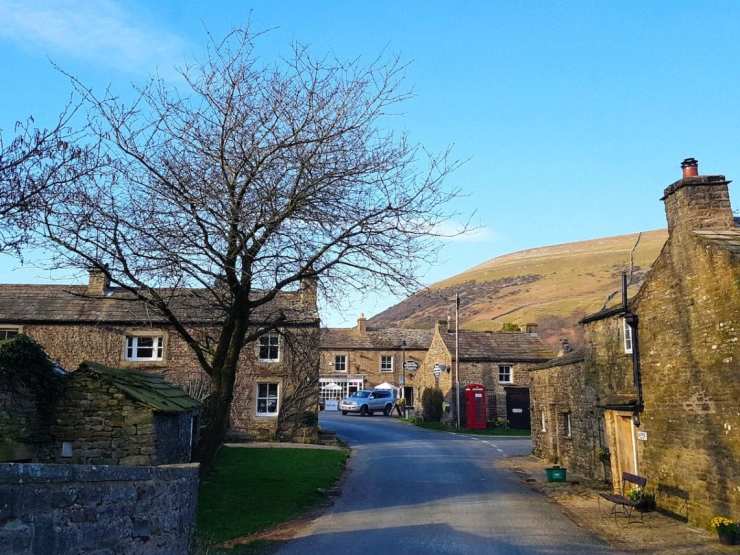
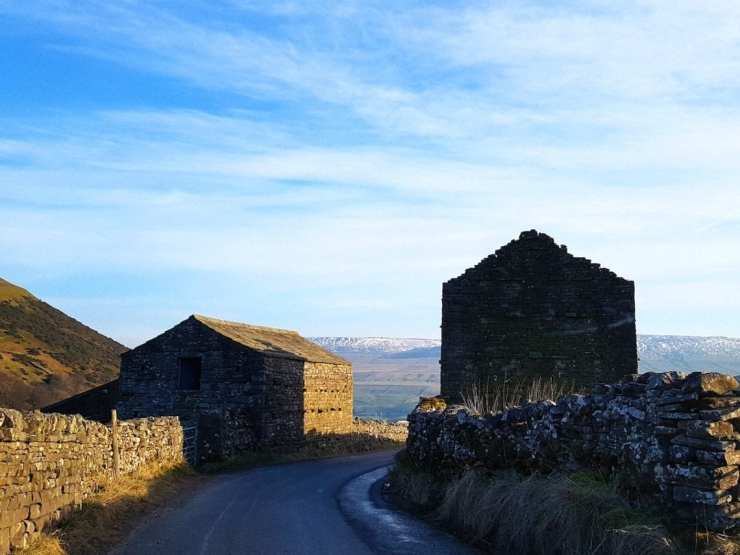
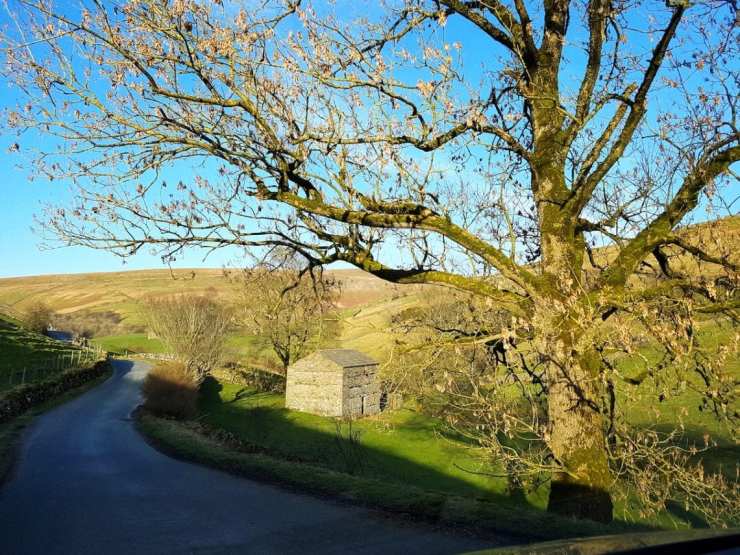
Lengthy conversations with locals apart, we drove around the Yorkshire Dales. Now the dales are about pure tradition. It starts from the way the farmers tend to their land, roaming around the country lanes with collies perched upon the back of their quad bikes, as they send gruff smiles your way. Dry stone walls patch work lush rolling slopes and meadows while limestone barns pop up all over the latticed landscape.

Then you see cottages carved out of local stones, ruined remnants of 18th-19th century lead mines, small waterfalls, bales of hay stacked up by the meadows, ancient woodlands, small stone bridges and gurgling brooks flowing through the valleys. At the end of the noon, droopy as a dog, you step into an old, traditional pub with stone-flagged floors and large fireplace, plonking yourself at a table in the garden. The drill goes thus: Chug on pints of local ale accompanied by no-nonsense pub food. Gastro pubs look the other way. Your neighbours will be cyclists, motorcyclists, many sizes and shapes of dogs along with their owners, and oodles of walkers. As the honey-golden sunshine of the noon softly touches upon the face, you smile away the sunburn you have acquired during your rambles and you know this that the dales have got you good.

2017-03-26 12.25.55 1.jpg

Reeth

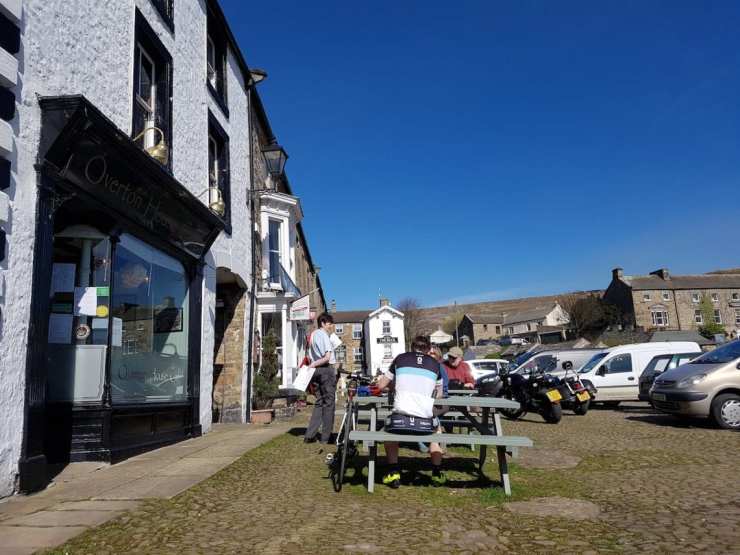
An expansive stretch of village green, a local postwoman making her daily rounds in the village, a coffeeshop with tantalising cakes, a tiny convenience shop, three village pubs (who said that they did not want you to be spoilt for choice in Reeth), two churches and a smattering of stone houses. You have entered Reeth. A village in upper Swaledale that lies on the B6270 road. There are plenty of walks to do around it. Just head to its information centre. The old lady at the till will take her time in helping you out with suggestions.

2017-03-28 11.25.08 1.jpg
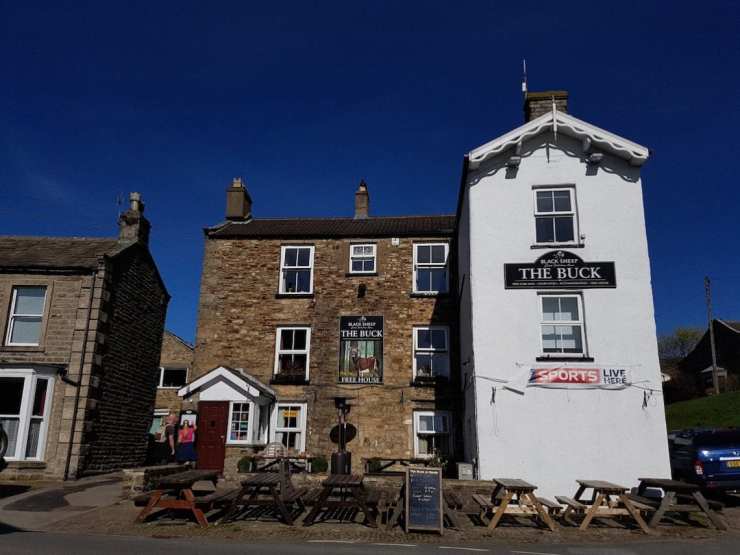
A historic coaching inn, The Buck, traces its way back in time to the 1700s. 
2017-03-28 11.25.11 1.jpg
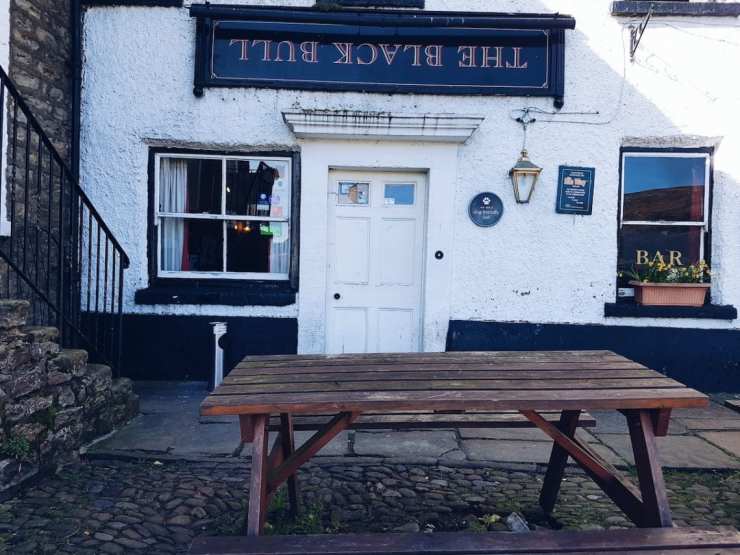
After a long time spent inside the longest surviving inn in Reeth (it dates back to the 1600s), things might look a bit different. Wait, are you seeing things upside down?
2017-03-28 11.25.06 1.jpg
Postwoman of Reeth.
2017-03-28 11.25.04 1.jpg
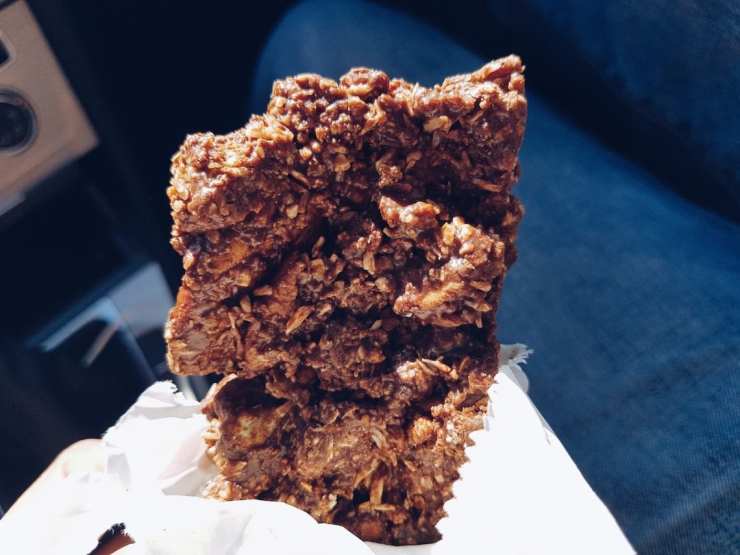
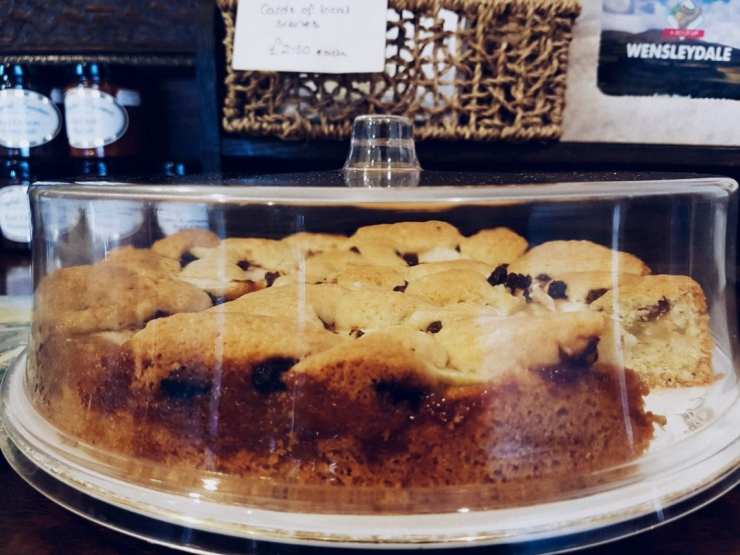
The chocolate biscuit cake stole the show. Laden with chewy oats, nuts, lots of butter, chocolate and raisin, it was all mine. Adi turned up his nose at it. Men are odd.

Muker

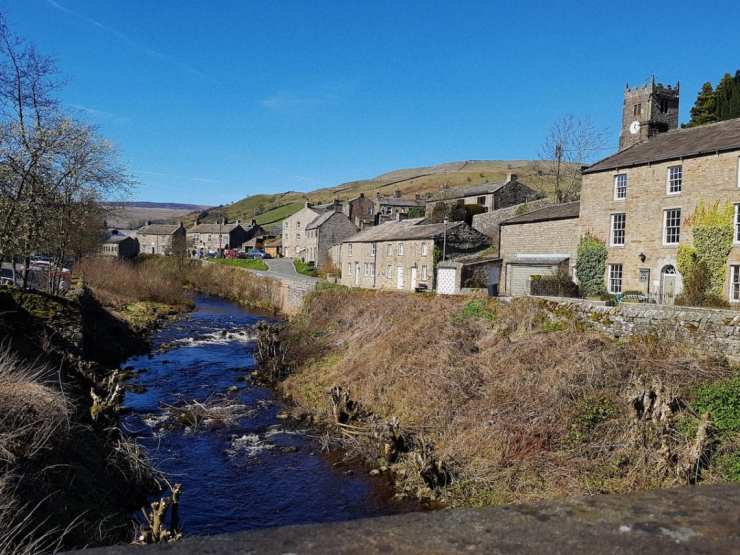
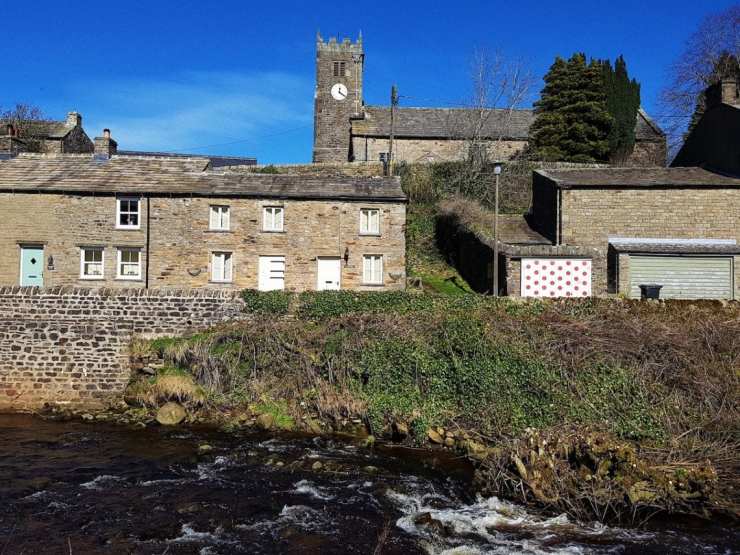
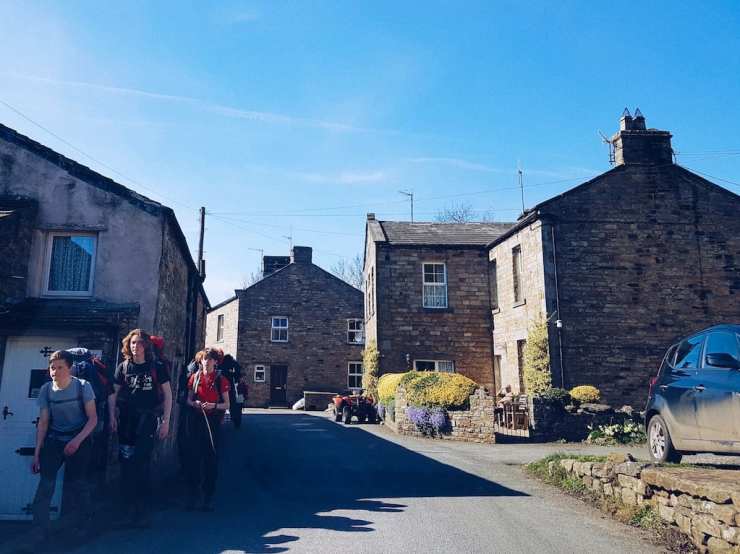
This was our starting point for the walk to Crackpot Hall.nMuker Beck runs through the tiny village where a handful of houses stand next to the river and a ribbon of a road runs past them. You can see the church peeking out from above the stone cottage with the creepers. In the old days you might have been witness to all significant occasions in the life of the poor folk taking place in this church made of wattle and daub and heather thatch. They walked miles and miles to get here for weddings and burials. This single church in Muker is historical – it is one of a handful that came up during the reign of Elizabeth I in the 1600s.

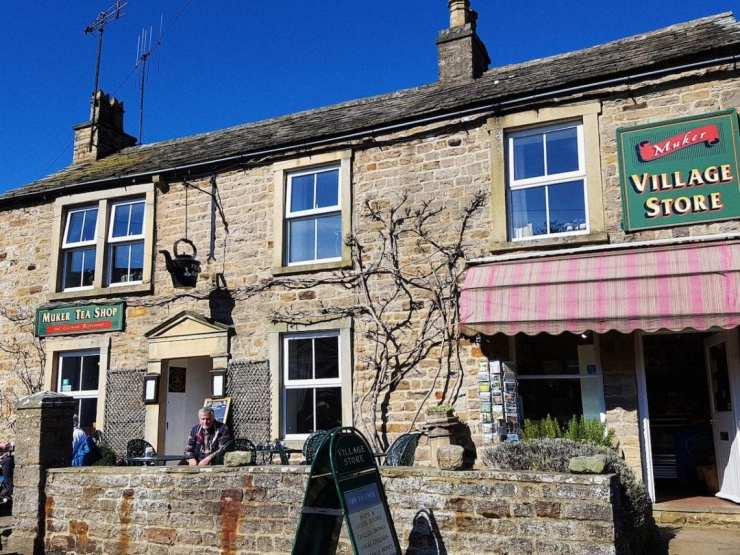
The dales believe in minimalism. A village shop and tearoom come together as a package, a pub stands next door and then you have a boutique selling Swaledale woollens, which displays a placard informing you all-importantly, it was graced by the presence of the Prince of Wales. After such a clear sign, if you want to buy anything (at extortionate prices), let it be upon your head.

2017-03-28 11.24.46 1.jpg
Muker Beck runs through the town which was an important post for the lead mining industry in the old days.
2017-03-28 11.24.47 1.jpg
St. Mary’s looms up above the cottages of Muker.
2017-03-26 07.30.33 1.jpg
Blue doors
2017-03-26 07.30.31 1.jpg
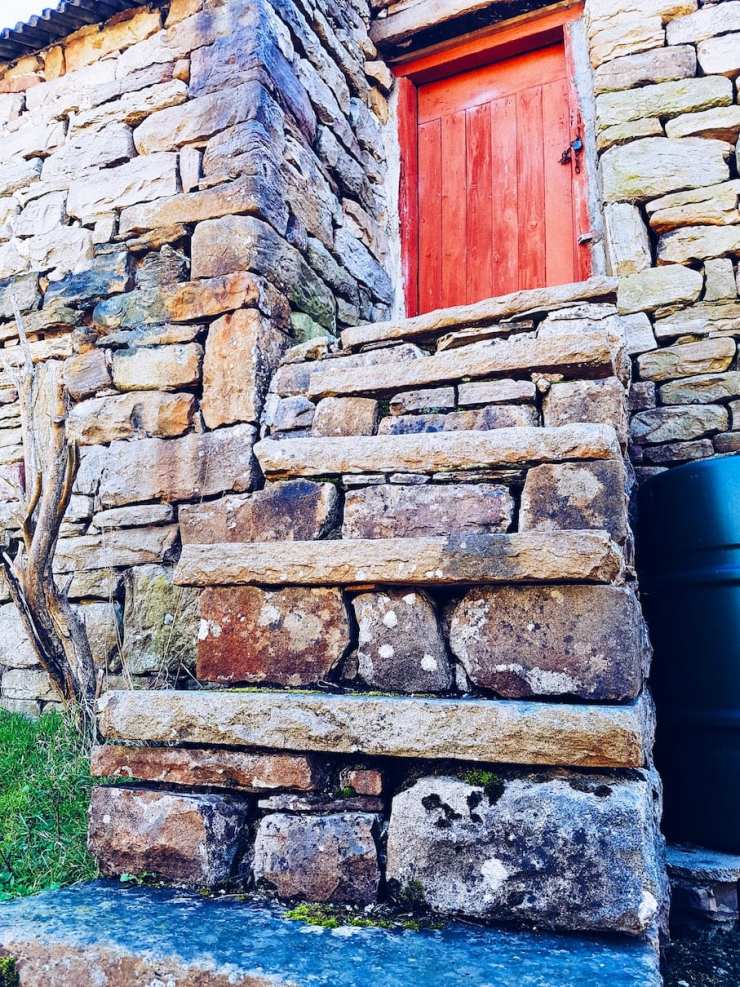
And red doors. It is easy to fall for Muker.
2017-03-28 11.24.43 1.jpg
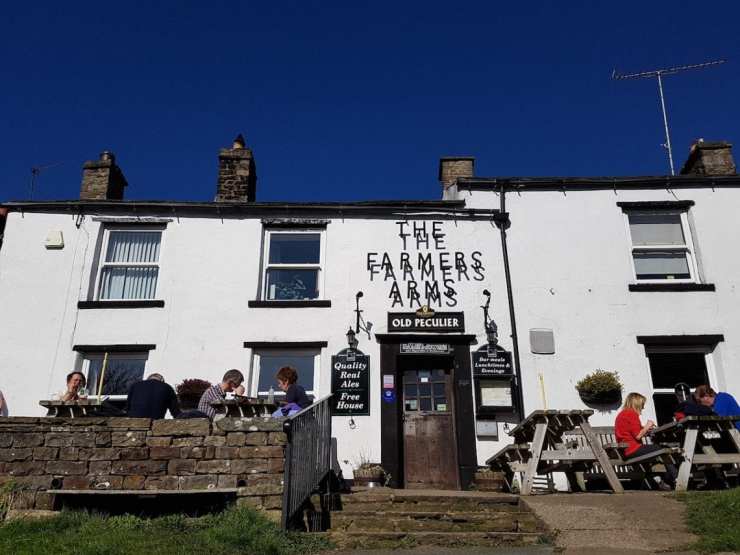
The only pub in Muker is this.
2017-03-28 11.24.45 1.jpg
The all-in-one tearoom and village store
Processed with VSCO with a5 preset
Goodies guaranteed to make the drool flow fast just like a mastiff.
2017-03-26 12.26.06 1.jpg
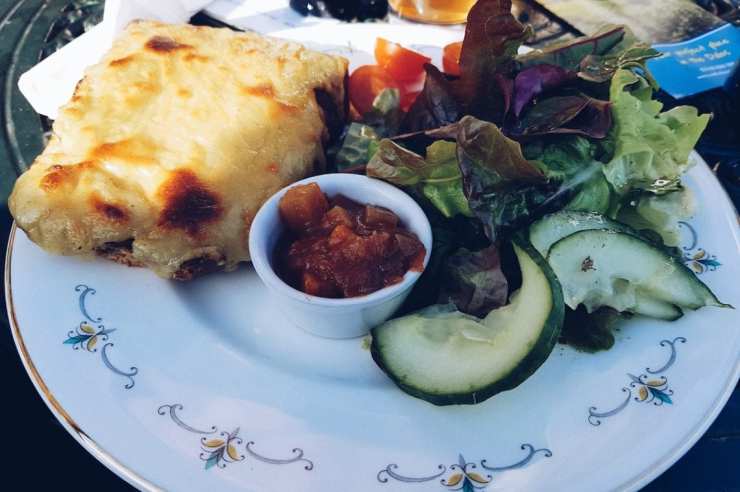
A Welsh rarebit with tomato relish and salad on the side.
2017-03-26 12.26.08 1.jpg
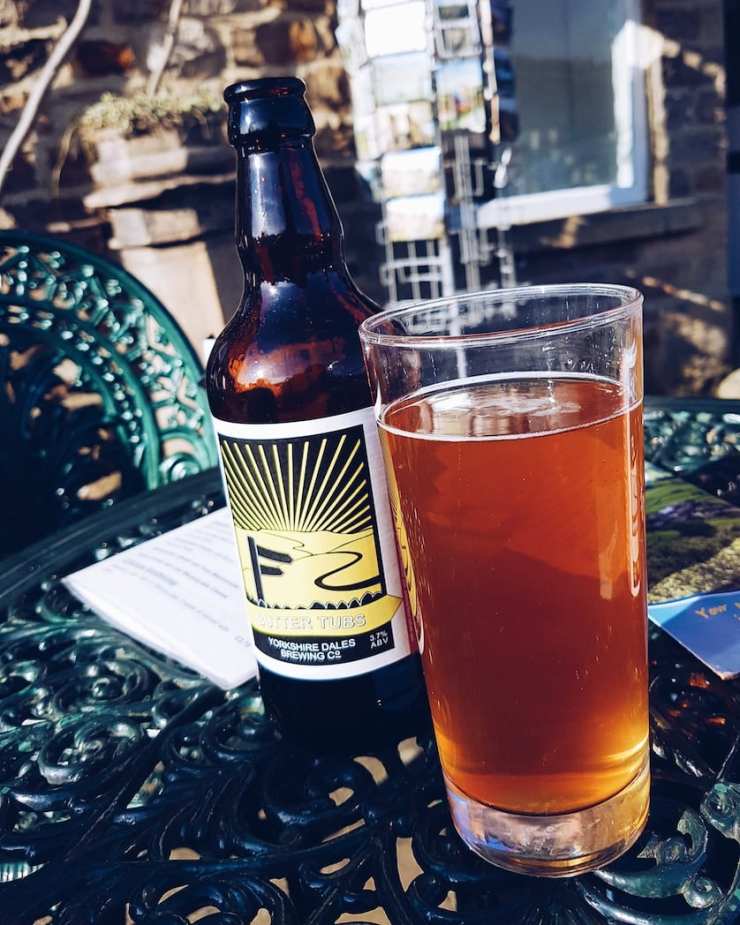
Butter Tubs, a pale golden, dry bitter ale. Delicious after a hot walk.

Keld

One of the smallest and evocatively tranquil villages in the Upper Swaledale. It just has the Keld Lodge and one Butt House B&B. No shops. Yessir, you gotta get your supplies elsewhere because you shall get none in Keld. The original name of the village was Appletre Kelde (‘the spring near the apple tree’), derived from the Viking word Kelda (‘a spring’). Keld lies at the crosspoint of two challenging hiking routes in the country – the 267-mile long Pennine Way which spans the length of the Peak District to the Scottish border, and the Coast-to-Coast Way that runs from St. Bees in Cumbria to Robin Hood’s Bay in Yorkshire. And get this: During the height of the lead mining industry, Keld had about 6000 inhabitants. Today it has less than a 100 villagers. There’s a reason to fall in love with the villages in the dales.

2017-03-26 12.25.56 1.jpg

Gunnerside

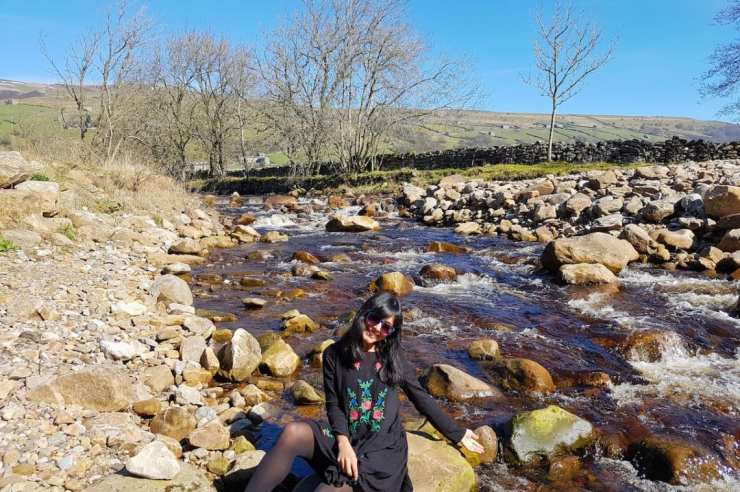
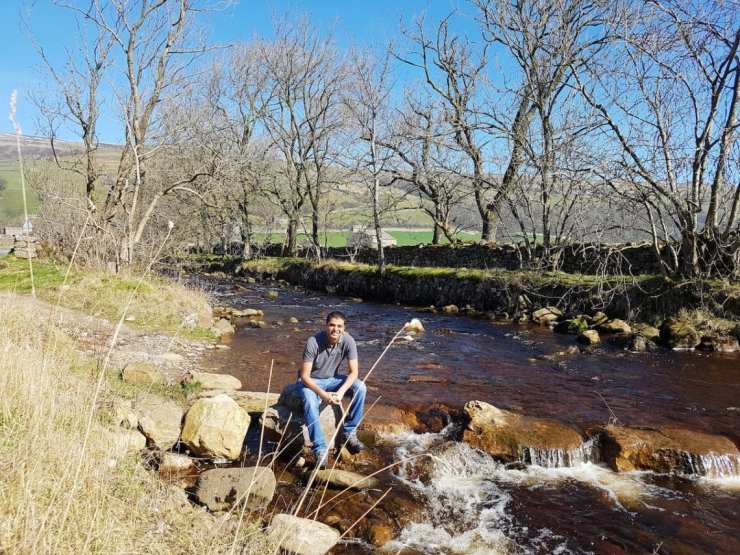
Gunnerside country is curiously flat and the farmers here stick to the traditional methods of farming. A methodist chapel, a smithy, a pub, a primary school and a post office are all you shall spot within this small settlement that gets it name from the Nordic word Gunnar’s Saetr, meaning the ‘Viking king’s summer pasture’. Somehow it is difficult to imagine the Vikings on this flat, serene landscape, but if history says so, who am I to bicker. When we made a stop by the beck in Gunnerside, a man hiking through, his shirt open till his waist, stopped for a brief hello. One of his lines got stuck in my mind. “They say this is the Yorkshire Riviera. Today, you can’t doubt it.”

2017-03-28 11.24.58 2.jpg
Gunnerside Flats
2017-03-28 11.25.00 1.jpg
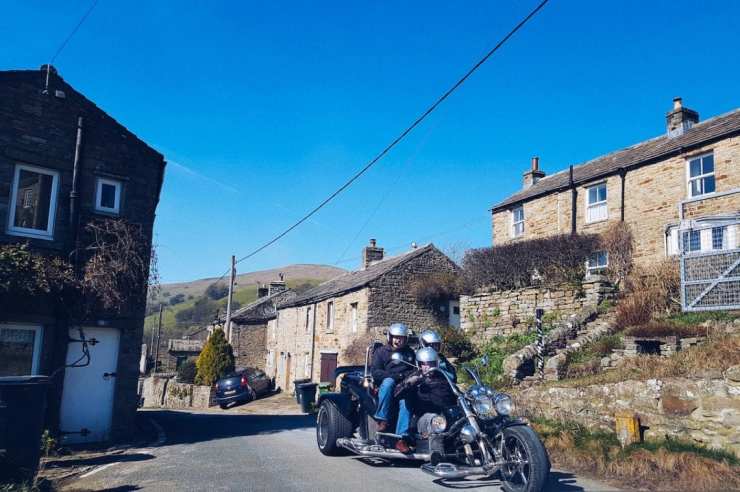
A Harley trio in Gunnerside
2017-03-28 11.24.50 1.jpg
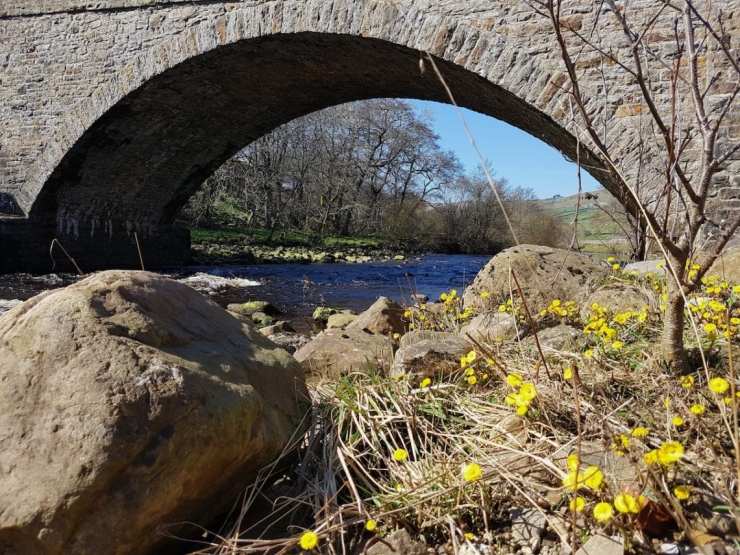
The 19th-century New Bridge
2017-03-28 11.24.54 1.jpg
Gunnerside Beck
2017-03-28 11.24.58 1.jpg
Boys out spring camping
2017-03-28 11.24.56 1.jpg
“I chatter over stony ways, /In little sharps and trebles,/ I bubble into eddying bays,/ I babble on the pebbles.” Tennyson to add to the beauty of it all.

Thwaite

I have got a surprise for ya. The Scandinavians were in Thwaite. Well, you would say duh by now. Which means you are reading this, plus you would be right too. Naturally Thwaite gets its name from the Old Scandinavian word thveit which means ‘meadow or paddock’. I just remember the barking of dogs in the distance in Thwaite and a farmer passing by in his tractor loaded with a bale or two of hay. There was not another soul to be seen in the village and these are scenes from an early evening.

2017-03-26 12.25.49 1.jpg

2017-03-26 12.26.02 1.jpg

2017-03-26 12.25.54 1.jpg

2017-03-26 12.25.36 1.jpg

2017-03-28 11.24.49 1.jpg

2017-03-26 12.25.58 1.jpg

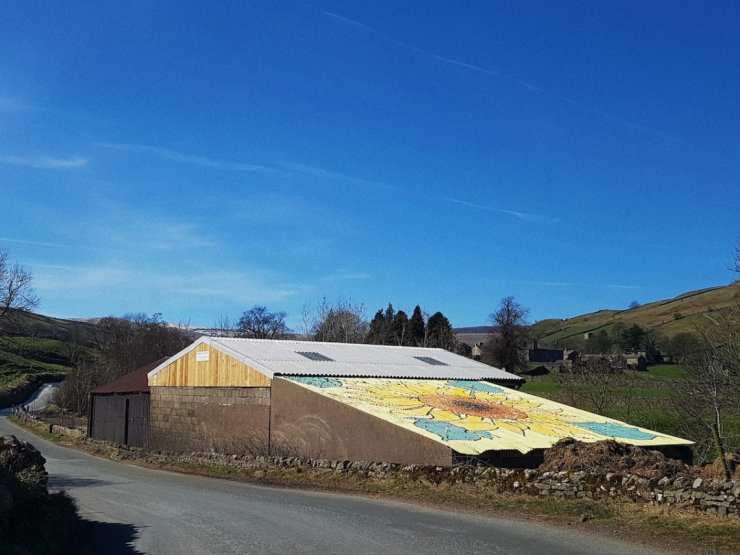
That is all. With massive motifs of sunflowers, sheep, dry stone walls and limestone barns popping out of the landscape, we drove into the sunset.