
…were couched the beginnings of a 250-year-old tradition in the family I was born into. That of worshipping the goddess Durga. Ma Durga as we call her in West Bengal. Ma as in mother, the beginning of everything that is good on this planet, in every species. Even crocodiles and snakes (ophiophilists, don’t you dare fling a cobra at me).
Durga is the warrior goddess who slays evil and preserves peace by combatting with the ashura, the demon in Hindu mythology. And she is not modest, okay? How could she be, this 10-armed goddess who multi-tasks effortlessly as only a woman can. In the Rig Veda, one of her aliases Devi is noted to have remarked, ‘I am the Queen, the gatherer-up of treasures, most thoughtful, first of those who merit worship…’
For Bengalis, and most of the eastern part of India, her arrival brings with it a celebration that lasts for days. Five at the least. When the number of days perchance decrease, there is a sea made up of ripples of melancholic faces.
What! To be shortchanged thus? Lesser number of days off from work, the chance to show off new clothes acquired for each day and most importantly the opportunity to do pet pujo. Pet is stomach in English and pujo is worship. You get the crux of the matter and where I come from with my bottomless-well kind of appetite.
Roads and alleys are blocked off in the city of Calcutta for the hundreds of community pandals, temporary pavilions, that emerge all over the city, each vying with the other for greater glory. There are various interpretations of the goddess therefore, some staggeringly flamboyant. Once they even had a Harry Potter theme which made my eyes boggle. Sheer genius of someone’s imagination to inject fantasy with more fantasy. It is the one sight that will be imprinted on your mind for a long, long time if you visit the city during Durga Pujo. In a good way. There is bloody chaos, because it is India, what do you expect? Yetin that chaos you shall find peace by gaping at the many reincarnations of Durga around every corner, plethora of street food that will make you go ‘aah’ (with supreme gastronomic pleasure) and ‘ooh’ (the stomach shall inevitably protest) and more food yet in the many classic eateries in the city. If the world eats to live, Bengalis do it the other way around.
Then there are family pujos which are smaller affairs but filled with intricate details that you will miss out at the community ones. That’s where my family comes in.
Years and years ago, as I mentioned at the outset, when East Bengal was still East Bengal, before partition happened when they were dispossessed of their lands and it was named Bangladesh, generations of my ancestors (both my father and mother’s folks) lived there. My father’s and one of my great (I do not know how many times great because my father is the one well-versed with the family tree) grandfathers’ boatmen dreamt of a goddess. As irreverent as I am, I often wondered if he had smoked a few spliffs, but then in his defence, the man did locate the goddess who apparently appeared in his dreams.
A tiny idol of Annapurna made of ashtadhatu (eight metals – an amalgamation of gold, silver, copper, lead, zinc, tin, iron and mercury) was recovered by him from a certain spot that was revealed to him in the vision. Annapurna is the goddess of nourishment (she who wants you to be well fed always) and Durga personified. The boatman passed on the idol to his employer, my ancestor, who started this ritual of worshipping Durga on his land. Unknowingly he had started a legacy that has tempered the outlook of so many generations of my family after him.
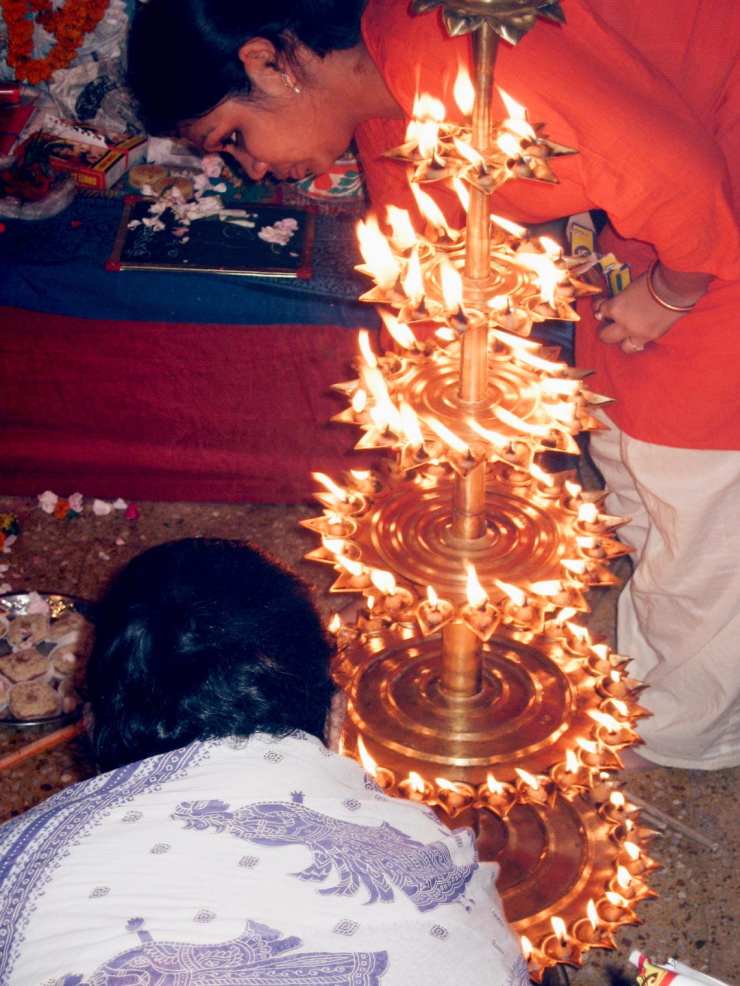
Now the pujo is rotated among three family members – two of my father’s cousins and my father. Last year I flew back to Calcutta because my parents who are ageing away at a meteoric pace were sure it would be their last time celebrating it at home. ‘You never know,’ they said, and as much as it hurts, it is the inevitable truth of life I suppose.
As a child, I would wake up early and gather flowers in my skirt from beneath our trees. Some wild purple and white ones, blood-red hibiscus and then mounds of shiuli, the night-flowering jasmine. I would knit garlands out of those pretty night jasmine with their coral center and stems for presenting to the goddess. Then fast for the offering-of-flowers ritual that happened with chantings of shlokas by the family priest during the latter half of the mornings. I would sin by sneaking food into my library room from the kitchen during those times when I was supposed to fast, little orbs of goodness made up of coconut, sugar and milkmaid. Then noons of dressing up and escaping the family to spend time with friends at pandals where the young and beautiful flock together to observe each other with a gimlet eye. And day and night of feasting on delicious Bengali food that comes to an end with the final/10th day of the pujo when we immerse the goddess into the river.
That is when the entire family – the very old and babies barred – we all pile up into a large lorry and rumble down the roads with Durga and her sons and daughters and demon and chant, ‘Aschhe bochhor abar hobe‘ (roughly translated, ‘the following year she shall be here again’) before we slide her gently into the waters of the Hooghly and douse our grief with food, but of course. A feast that kicks off with giant fried sweets, followed up with plenty of fish cooked in mustard, mounds of rice, mouthwatering range of veggies and chutneys.
Autumn for me is the arrival of this festive air. It steals in upon me, arrival of the goddess when the breeze softens, when the skies put on their dreamy blue veil, the merest hint of winter in the air and the long white grass we call kaash phool, a sort of perennial white grass which sways in the wind with immeasurable softness and grace. As much of a non-believer as I am, I bask in the goodness of it because what would life be without traditions. As witty Whitman had declared without a trace of shame: ‘Do I contradict myself? Very well then I contradict myself, (I am large, I contain multitudes.)’



 ARUNDHATI BASU