Far From the Crowds on the Amalfi Coast…

… are Scala and Ravello. They reinforce what the Gambardella sisters, owners of a 19th-century hotel on the coast, pointed out once. That ‘there are bits of the old life left on the coast, but you have to know where to find them.’ You do get more time to linger in spots you take a fancy to without having someone breathing down your neck.  

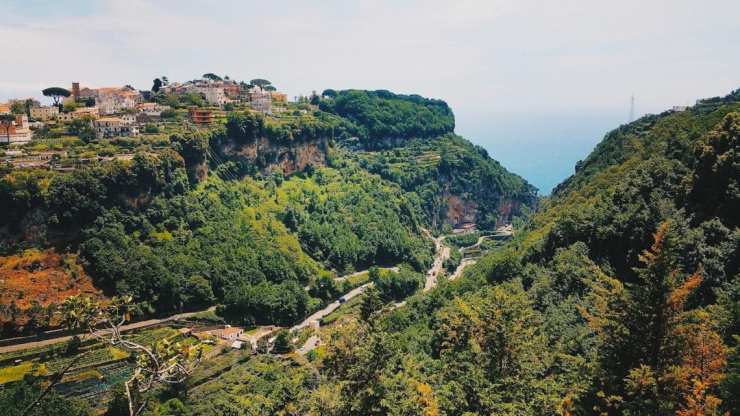
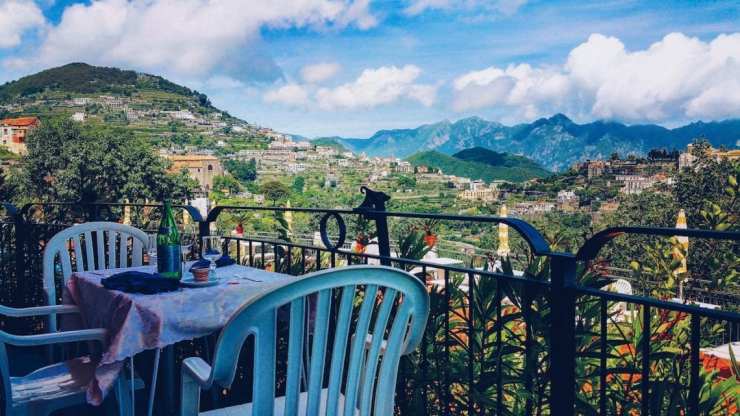
Scala is a sleepy village. Period. Apart from some dogs in a farmhouse excited by the sight of us passing by, we did not see many people. We sat on the terrace of a family-run trattoria in this oldest village on the Amalfi coastline. In our field of vision  was a landscape bathed in the glorious sunshine – the kind of view that made our wait for the food to arrive extraneous.

We sipped on limoncello – I mean you have to give into everything that’s yellow on this holiday – and slipped into a reverie, the kind that slowly descends upon you in the midst of all that lush beauty.

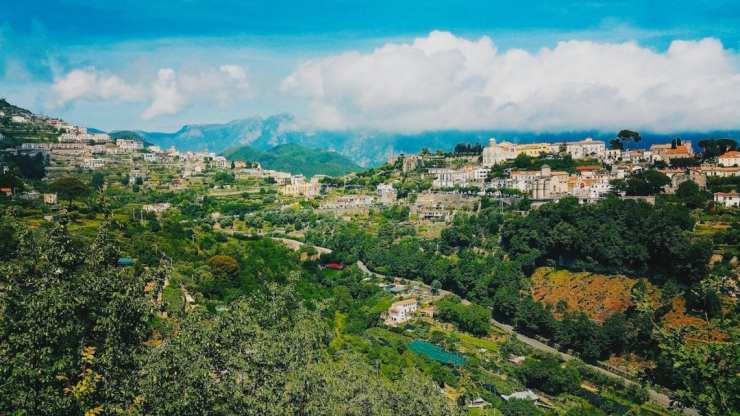
There was what man had built into nature — but it all came together quite effortlessly. Among orchards of lemons and piennolo (grape-like) tomatoes, white houses and terracotta roofs, church domes and an assortment of trees, climbed in conjunction, layer upon layer, on steps cut into the hills. Unbroken batches of puffy clouds floated by smothering the hill tops in the distance, imparting the scenery with an illusory touch. When you turned your head, you could see the winding roads cutting through the valley. Those roads had brought us up from the village of Atrani.

The 1000-year-old village of Scala had its heyday during medieval times when it was associated in commerce with the Republic of Amalfi. Many wealthy families lived in Scala at the time and it is reflected in the legacy of its duomo. However sizeable their fortunes were, in my books, they were wealthy by virtue of the splendid surroundings they got to live in.

I wonder if they knew how blessed they were. Because this would be my Illyria.
2017-03-08 11.00.21 1.jpg

Processed with VSCO with hb1 preset

2017-03-08 10.06.58 1.jpg

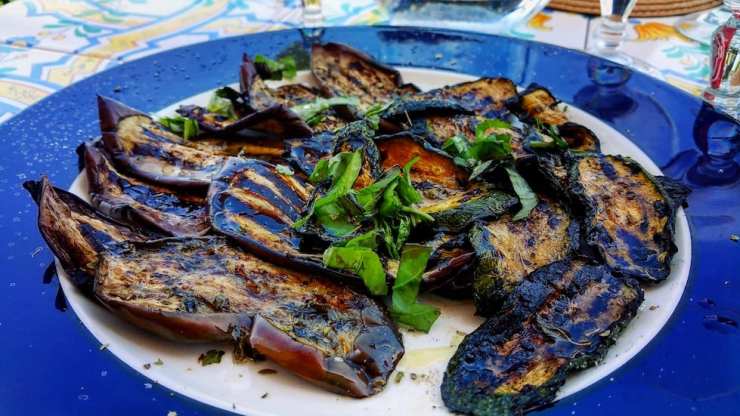
The food did arrive and I cannot describe in words how luscious the grilled aubergines were. They were the perfect accompaniment with limoncello on that terrace with a view.
IMG_20170213_150422_621.jpg

Where to Stay:

La Margherita Villa Giuseppina (http://www.villagiuseppinacostadamalfi.it/is a family-run bed & breakfast hotel in Scala. We ate here during our stop in Scala. It is unpretentious and serves up delicious fare. Standard double rooms, with breakfast thrown in, start at €120 per night.

ll Pinguino (http://www.pinguinobb.it/) is another family-run affair where double rooms are pegged between €80- €150 per night.

Things to do:

Hike the Valle delle Ferriere. Maps can be downloaded from the official website of CAI dei Monti Lattari (www.caimontilattari.it). The trek lasts about three hours.

Monastery of Santissimo Redentore

Palazzo Mansi-D’Amelio

Church of Annunziata in the hamlet of Minuta

Arab Bath in Minuta

Ruins of the Church of San Cataldo in the hamlet of Campidoglio

Ziro Tower, part of an ancient Scalella, in Pontone

Next up is Ravello, the last in the Amalfi Coast series.


A Luxembourgish Break

Here is a small duchy that packs a punch. In every way you can think of. I shall get there eventually. Make way for some rambling now, if you please.

A flight on an early morning from Heathrow landed us in Luxembourg’s only international airport. Without mis-adventures what are we? A public bus, for which we had to pay nothing (because on Saturdays they charge nada), took us past very modern and tall buildings into the heart of it when we suddenly realised that we had left our destination somewhere behind. They do not announce bus stops (they just want you to be observant individuals, darn it). So all you have got to do is keep a careful count of bus stops on the small brochure that the information desk at the airport hands you. Of course, we reached somewhere else. From where we sat in another bus with a driver who looked like he was not having a good day and reached our stop in a matter of a few minutes.

Yes, Luxembourg City is so small that you can conveniently walk around it without breaking a sweat. If you have two days in the city, I would strongly recommend getting a feel of the city in a day (it is that small and you will have seen everything, I promise) and the very next day head north to the Ardennes or south to the Moselle Valley. We did not get to do either of the two because we had to head home the next evening. So we just spent time mooching around town.

Now getting back to that statement about how and why the small capital packs a punch.

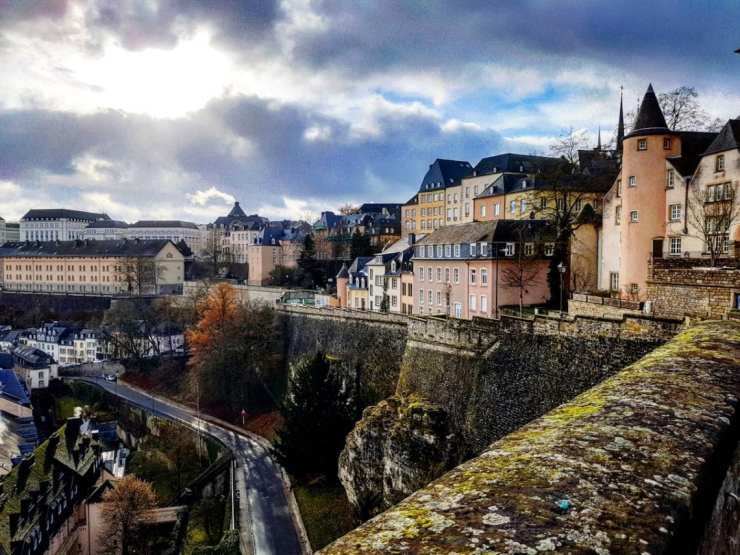
Firstly, the only remaining Grand Duchy in the world, ruled by Grand Duke Henri, does fairy-tale with flourish. Straddling two deep gorges, Luxembourg City is filled with pale pink chateau-style houses with turrets and towers, viaducts, sand-hued bastions peeping through, willows poetically drooping over emerald green rivers, spires of churches shooting for the heavens and stories of counts and dukes fighting for control of the tiny duchy. The father of this small land would be Siegfried, a count in the Ardennes – that rugged terrain which spans Belgium, Luxembourg, Germany and France and known for the fierce battles fought in it during the two world wars.

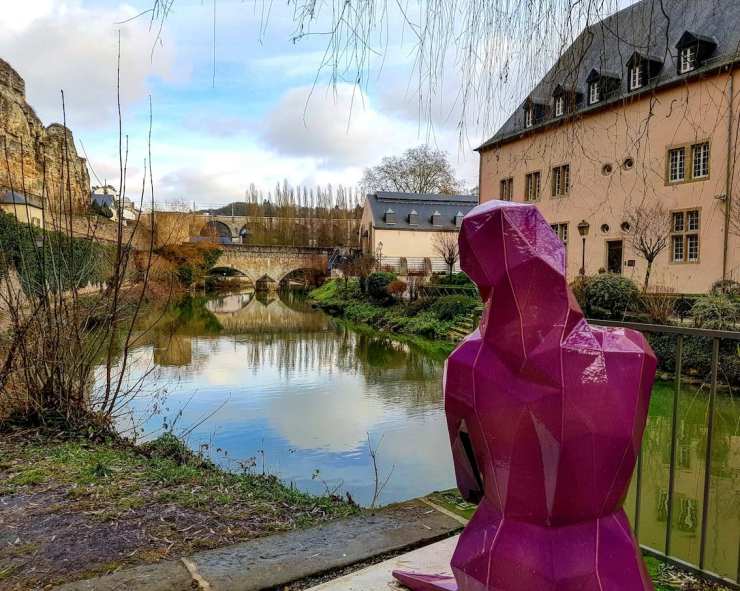
There is a legend that the count was lured to Luxembourg by a mermaid called Melusina whose domain was the waters of the river Alzette. Psst: You will see her soon. No, no, I am not trying to spook ya. Melusina truly sits by the river even today, very pink and thoughtful.

Melusina or not, Siegfried must have fallen in love with the rocky promontory known in those days (10th century) as Lucilinburhuc. That is if he was romantic. But if he was a shrewd ruler, he would have looked at the strategic position of it and thought of it as an excellent proposition for building a defensive fort. In any case, he paid for it with lands he owned in a nearby commune in Luxembourg to the Abbey of Saint-Maximin in Trier. Then having acquired it, Siegfried proceeded to castle up. Around which the town came up.

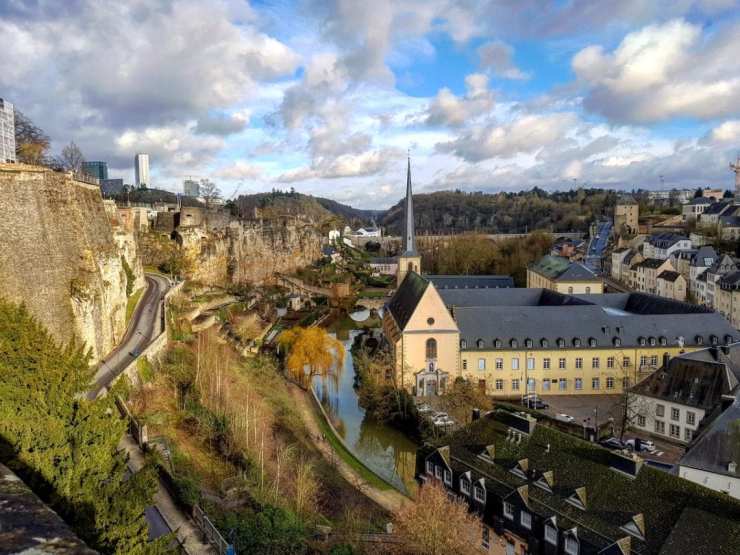
Instead of paying up a hefty 18 euros per person for a tour of it, we did a self-guided walk. The walk around the promontory that is called the Bock, the gorges and the fortifications is just too charming. You cannot take your eyes off the view from every part of it. The viaduct with rows of cypresses standing like tall, spare soldiers alongside, the startling sandy hues of the sandstone cliffs that glow so golden in the sun, the roads winding down from the plateau to the lower part of town, the glassiness of the Alzette and then the blue palette of the sky in the backdrop. It all comes together like a dream.

Secondly, this is a city that thwacks you solid when you are hungry or thirsty. Wander into any restaurant and Luxembourg City will make you see stars. A cup of coffee in a cafe will set you back by 4.50 euros. Nothing is for the hoi polloi here. In fact, I suspect there is nobody who would qualify as a commoner in Luxembourg City. The average salary monthly there is 3,189 euros. So dear friend, if you have felt poor in Luxembourg, you are not alone.

I had a premonition at the airport. A blueberry muffin and a cup of coffee at a stall in the airport cost us 11 euros. The kind of price I would expect to pay at a fancy old-world cafe in Europe. Boy, were we glad that we were there just for a night.

Thirdly, it has one of the best chocolateries in Europe. That is reason enough to make me go wild. With chocolate. Who wants anything else in this world? Wait. Don’t answer that. Just humour me.

IMG_20170117_181527_088.jpg
Ah, that view from Chemin de la Corniche which is considered to be Europe’s finest balcony. It is a cobbled promenade from where you can have a wonderful insight into why the city had captured the attention of Holy Roman Emperors to the houses of Burgundy and the Habsburgs. Why, everyone wanted a bite of it, including the Prussians, and the French and Spanish kings.
IMG_20170117_205749_321.jpg
On the left, you see the Bock. From which the city gets its epithet, Gibraltar of the North.
IMG_20170117_210539_065.jpg
Every angle of it is the subject of a few clicks.
img_20170117_210319_835
His imagination ran riot here. Above him are loop-holes in the Bock cliffs for canons that once were stationed there.
20170117_225009.jpg
There you go — Melusina. She gave Siegfried seven children but he refused to give her space. The story goes that she used to lock herself up on weekends, and egged on by his friends, the count gave in to peeping through the key hole of her locked door. “O ye of little faith, Siegfried,” she might have said, but what she definitely did was vanish. He never saw her again. 
IMG_20170117_180725_497.jpg
The city stands at the crossroads of two important Roman routes that ran through it. Straight ahead in the quarter known as the Fishmarket (at the junction of the Roman roads) stands the oldest church (it goes back to the 1oth century) in the city, St. Michael’s.
IMG_20170117_181048_553.jpg
Church of St. John, home to one of the few hundred Black Madonnas in the world. In the courtyard, stands the Neumünster Abbey. From time to time, it has served more the function of a prison and barracks than as an abbey. During WWII, the Nazis used it to imprison those who protested their occupation of the city.
IMG_20170117_205127_651.jpg
Luxembourgers in the old days would enter or leave the city, always watched by soldiers on duty at the gates. The gates would be shut once the sun set, not because they feared attacks, but because they were paranoid about desertion of their own troops. Apparently, it was a common feature for a large part of the troops to leave town in the cover of the night.
IMG_20170117_205552_360.jpg
Pont du Château, an 18th century two-story road bridge. Before 1735 when it was built by Austrians, there used to be a wooden drawbridge that connected the Bock with the upper parts of Luxembourg City. But if you want to make the connection through the Pont du Château, it gives you four options. You can walk over it of course. But if that seems too staid, you can pop into a spiral staircase that is located under the main arch, or walk the passage under those small arches. Better still, disappear underground into a tunnel and emerge in the upper city.
IMG_20170117_205402_162.jpg
We met barely a handful of people as we made our way down steep, winding paths to this church. But in the 18th century, this very place must have been swarming with people. For one, the citizens of Luxembourg were bound by “a sad privilege” as they had stated in a petition then. They considered themselves to be “living in a fortress, a privilege that is inseparable from the lodging of soldiers”. Both groups, soldiers and citizens, were thoroughly miserable, living in cramped conditions and constantly jostling for space.
IMG_20170117_205304_294.jpg
The husband and very own guide armed with a map takes a breather as we descend into the valley of the Alzette.
IMG_20170117_211356_686.jpg
Chemin de la Corniche in our backdrop.

Grund

IMG_20170117_211634_591.jpg
Views from Grund, a quarter below the city on the banks of the Alzette.
IMG_20170117_210747_696.jpg
Roads that lead to Grund.
IMG_20170117_224529_866.jpg
The houses of Grund, the quarter with just about 750-odd residents.
IMG_20170117_224627_195.jpg
In these alleys are the European headquarters of Amazon.
IMG_20170117_211729_674.jpg
Houses on the Grund.
IMG_20170117_222207_347.jpg
And then, there are these houses too in Grund, on the Alzette.
IMG_20170117_222258_821.jpg
From Grund, you look up and spot Old Town.

Old Town

img_20170115_182558_912
Let’s wander into its alleys.
IMG_20170117_224306_308.jpg
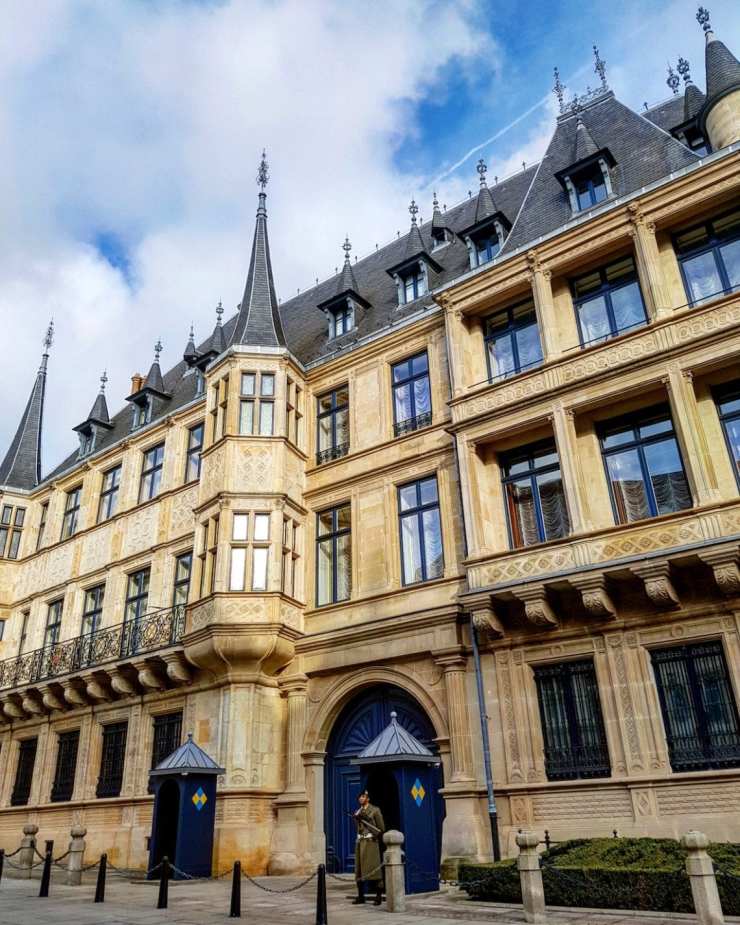
The Grand Ducal Palace
IMG_20170115_165525_652.jpg
Right opposite the palace will you see this piece of treasure.
IMG_20170117_222824_155.jpg
Inside a 15th century house, you will find just a wonderland of chocolate, European style.
IMG_20170117_222752_391.jpg
Those cakes are luscious enough to make you hungry even if you are not.
IMG_20170117_224036_772.jpg
Now this should back my statement up. Can you imagine the creamy goodness of this red velvet cake on your tongue? Are you feeling immensely greedy? Want to chase me with a club? I am done here.
IMG_20170117_222923_773.jpg
Bob Marley, Kafka and my man watch me as I unleash a vast reservoir of appetite.
IMG_20170117_223034_676.jpg
Mint tea. No I did not have that. I had something more sinful in store for me.
IMG_20170117_223003_005.jpg
It started with this stick, a big block of dark chocolate at one end of it along with a shot of cointreau in that plastic vial.
IMG_20170122_203839_719.jpg
That is how you bring a short holiday to a smashing end. With adequate amounts of hot chocolate, cliffs, spires, ditzy roads winding all over the place. And an odd yellow crane in the backdrop. Because life is a tale full of anti-climaxes.

Thus we wind down to the end of my short but sweet time in Luxembourg. Till next time, toodles.